
The first question most founders ask us is not 'how much?' It is 'how long?'
That makes sense. Every week you wait is a week without users, without feedback and without proof that your idea works. So if you are asking how long it takes to build an MVP, here is the plain answer.
Most focused MVPs take 4 to 8 weeks. Some are faster and some take longer. The time depends on what you build, how clear your plan is, and how quickly you give feedback. It does not depend on how fast people type.
In this guide we show typical timelines for each type of app, where the time goes, what slows projects down, and how to ship faster.
The short answer
- A simple tool or landing page can take 1 to 5 weeks.
- A typical SaaS MVP takes 4 to 8 weeks.
- A mobile app or a marketplace takes longer, often 6 to 12 weeks.
- An AI chatbot or automation can be quick, because much of it uses ready-made parts.
These are typical ranges, not promises. Your own plan can be shorter or longer, and we explain why below.
Timelines by app type
Here is a simple guide. It assumes a small, focused first version, not a full product with every feature.
| App type | Typical time | What it usually includes |
|---|---|---|
| Landing page with a waitlist | 1 to 2 weeks | A few pages, a sign-up form, basic tracking |
| Simple web app or internal tool | 3 to 5 weeks | Login, one main job, a simple dashboard |
| SaaS MVP | 4 to 8 weeks | Login, one core feature, payments, a dashboard, an admin view |
| Marketplace | 8 to 12 weeks | Two kinds of users, listings, search, messaging or booking, payments |
| Mobile app (iOS and Android) | 6 to 10 weeks | Login, core screens, notifications, store submission |
| AI chatbot or RAG tool | 3 to 6 weeks | Your documents loaded in, a chat screen, basic limits and checks |
| AI workflow automation | 1 to 4 weeks | A set of connected steps between tools you already use |
A few notes on this table:
- Marketplaces take longer because you build two sides at once: the people who sell and the people who buy.
- Mobile apps take longer because of device testing and the app store review, which you do not control.
- AI tools can be fast to build, but they need time for testing, because the answers must be checked for mistakes.
Not sure which row fits your idea? Our guide to MVP vs prototype vs proof of concept can help you pick what to build first.
Where the time goes
Most MVP projects follow the same stages. Here is a rough view of how the time splits.
| Stage | What happens | Rough share of the time |
|---|---|---|
| Discovery | We talk, agree the goal, and decide what is in and what is out | About a tenth |
| Planning and design | Screens, flow and a clear plan you can approve | About a fifth |
| Build | Writing the code, one feature at a time | About half |
| Testing | Fixing bugs and checking everything works | About a tenth |
| Launch | Going live, setting up tracking, handing over | A small part |
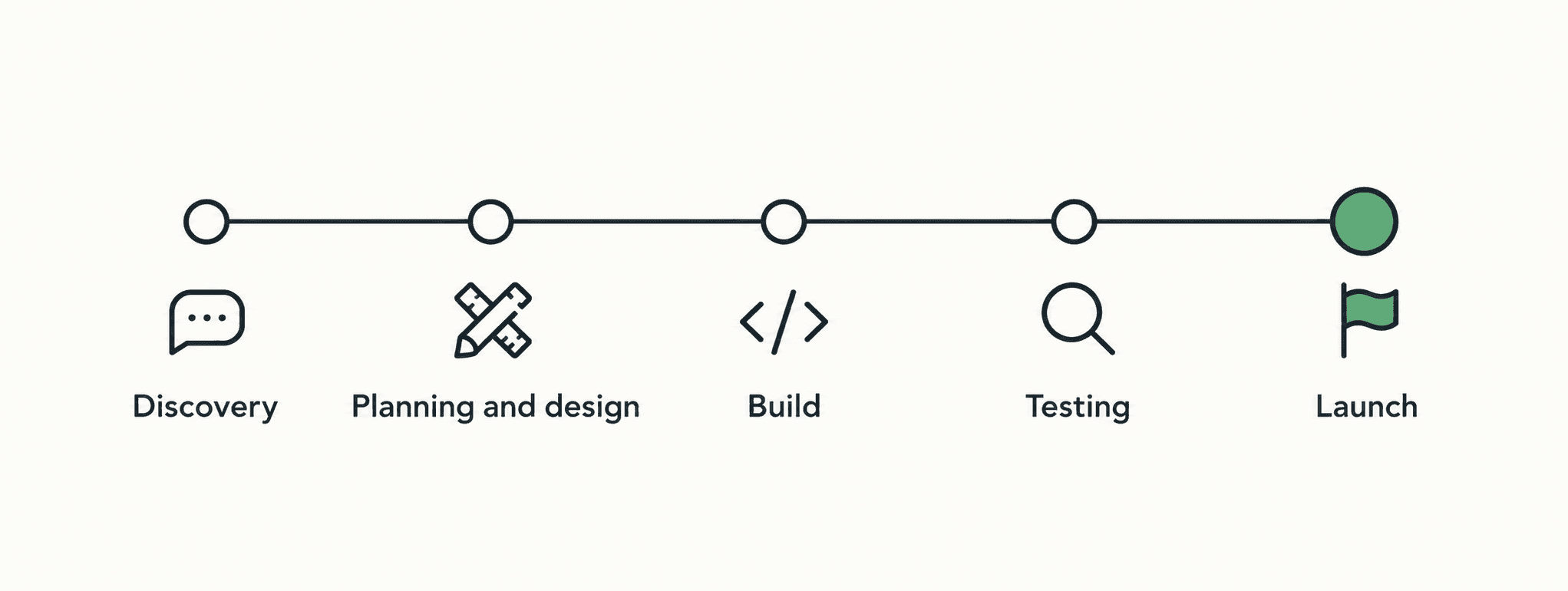
Building the product is only half the work. A rushed discovery and design stage often costs more time later, because mistakes found during the build are slow to fix.
What makes an MVP take longer
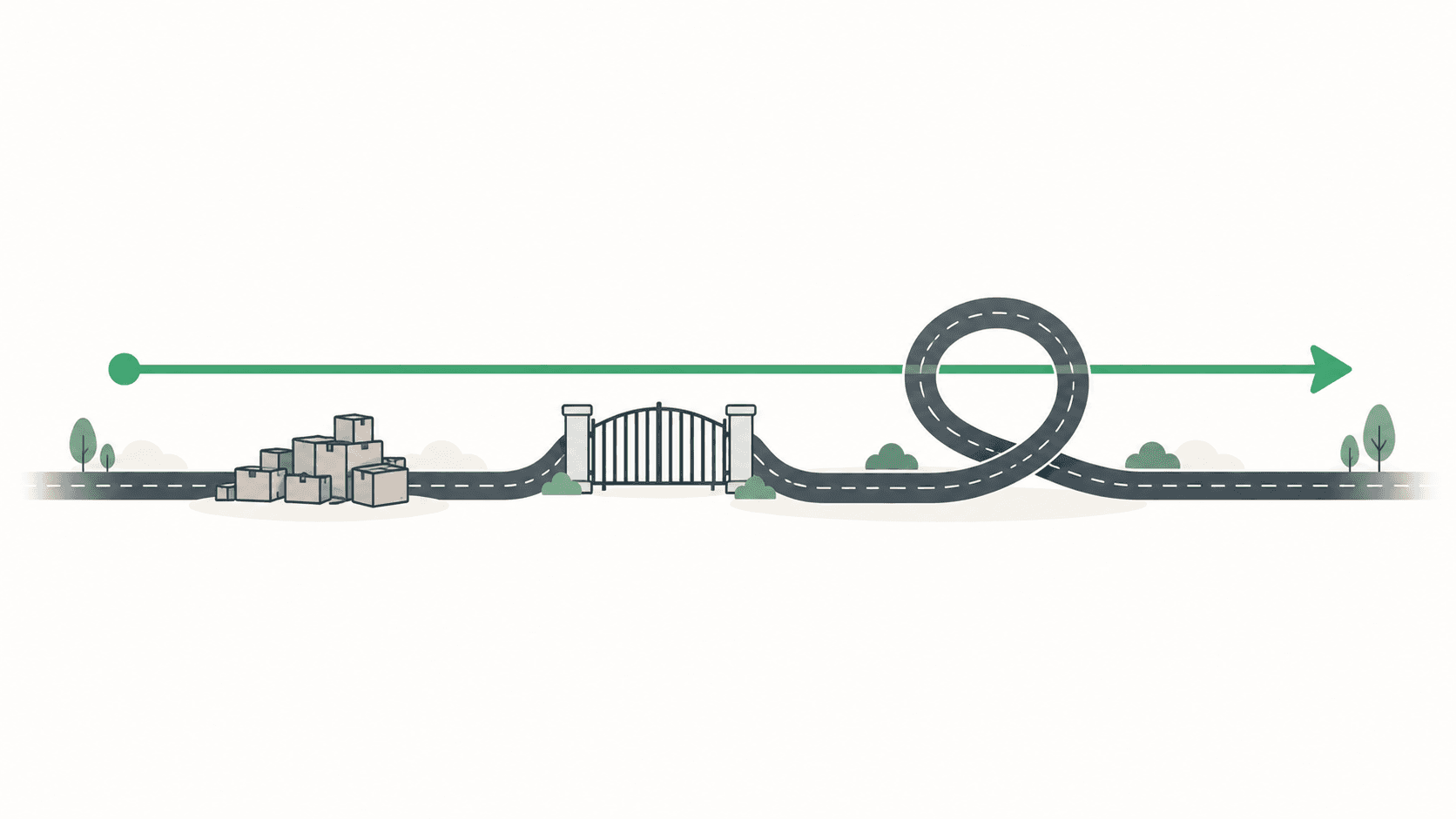
If your timeline is growing, one of these is usually the reason.
1. Too many features. This is the biggest cause. Every extra feature adds build time, testing time and more bugs. An MVP should do one main job well.
2. An unclear scope. If the plan changes every week, the work starts again each time. A written scope in plain words saves a lot of time.
3. Slow feedback. Builders cannot move on if they are waiting for your answer. A reply that takes three days instead of one can add weeks across a project.
4. Payments and money rules. Taking payments is not hard, but it needs careful testing. Subscriptions, refunds and taxes add more steps.
5. Third-party tools. Every outside tool you connect (email, maps, CRMs, other apps) adds setup, testing and sometimes waiting for approval.
6. Many types of users. An app with an admin, a manager and a customer needs three sets of screens and rules. One user type is much faster.
7. App store reviews. For mobile apps, Apple and Google review your app before it goes live. Plan extra days for this and for fixes if they ask for changes.
How to ship faster
You cannot rush good work. But you can remove what slows it down.
- Cut to one main job. Ask: what is the one thing a user must be able to do? Build only that. Everything else can wait for version two.
- Write down your scope. One page in plain English is enough. List what is in, and what is out.
- Use ready-made parts. Login, payments and email already exist as trusted services. Building them from scratch takes weeks and adds risk.
- Decide fast. Agree a time to answer questions, for example within one working day.
- Approve designs in one round. Collect feedback from everyone first, then send it once.
- Test with real people early. Show an early version to five users. Their feedback is worth more than a month of guessing.
The tool you choose also changes your timeline. We compare the options in our guide on freelancer vs agency vs vibe coding.
Your part in the timeline
Many founders think the timeline is only about the builder. In real projects, your part counts too.
Before the project starts, have these ready:
- A clear goal: who is the user, and what problem do you solve?
- A short list of must-have features.
- Examples of apps you like, so the design is faster to agree.
- Your content: text, logos and images, if the app needs them.
- Accounts for any tools you want to connect.
If these are ready on day one, the whole project moves faster.
A sample 6-week plan for a SaaS MVP
This is a simple example of how a 6-week project can look. Your project may be different.
| Week | Focus | What you get |
|---|---|---|
| Week 1 | Discovery and scope | A written scope and a list of what is in and out |
| Week 2 | Design | Screens and flow for you to approve |
| Weeks 3 and 4 | Build, part one | Login, the core feature, and a first working version to try |
| Week 5 | Build, part two | Payments, the dashboard, and fixes from your feedback |
| Week 6 | Testing and launch | Bug fixes, going live, and a handover |
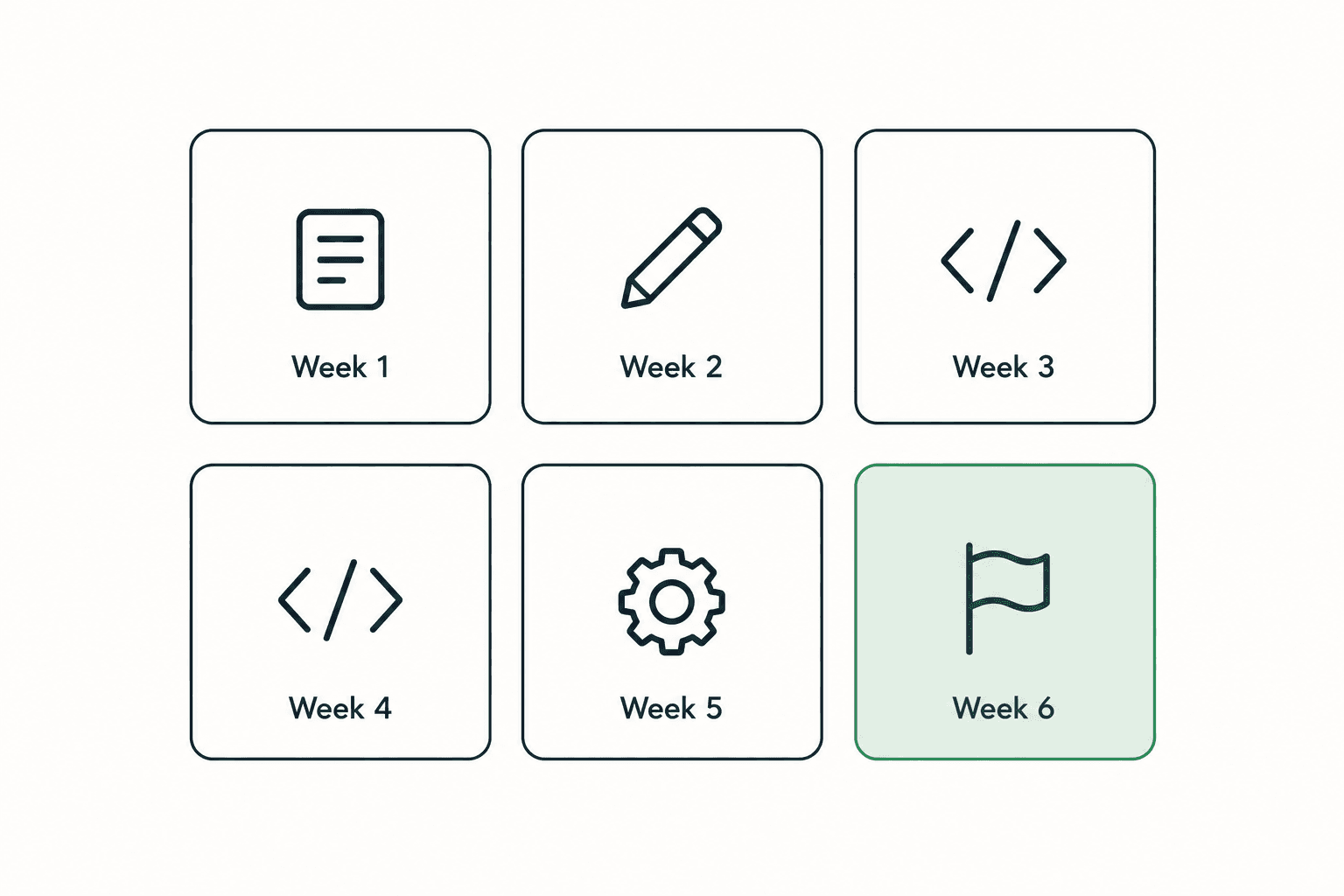
Notice that you see a working version in the middle of the project, not only at the end. This helps you catch problems while they are still cheap to fix.
Warning signs of a bad timeline
Be careful if someone says:
- 'Two weeks for everything.' A quick answer without asking questions about your product is a red flag.
- 'No milestones needed.' You should see progress at set points, not just at the end.
- 'We will decide the scope as we go.' This often means the timeline and the work will both grow.
- 'We will show you when it is done.' You should see working versions along the way.
A good builder asks you many questions first, then gives a range with clear reasons.
Our honest view
We are a small, founder-led studio. We plan most MVPs for 4 to 8 weeks, and we keep the timeline short by cutting scope, not by cutting corners. You speak directly to the person who builds your product, you see working versions during the build, and you own 100% of the code.
If your idea needs more time, such as a marketplace or a mobile app on two platforms, we will tell you that in the first call, along with what we could cut to ship sooner. You can read how we work on our MVP development page. If you have no technical co-founder, our guide to building an MVP without a technical co-founder covers your options.
Time and money are linked, so it is worth checking both. See our guide to MVP development cost, or try the free cost estimator.
Frequently asked questions
How long does it take to build an MVP?
Most focused MVPs take 4 to 8 weeks. Simple tools can be faster, and marketplaces or mobile apps can take longer. The main factors are how many features you want, how clear the scope is, and how fast you give feedback.
How long does it take to build a SaaS MVP?
A typical SaaS MVP with login, one core feature, payments and a dashboard takes about 4 to 8 weeks. Extra user roles, many integrations or complex billing add more time.
How long does a mobile app MVP take?
Often 6 to 10 weeks. Mobile apps need device testing and an app store review, which you cannot fully control. Building for both iOS and Android with one codebase can save time.
Can I build an MVP in 30 days?
Sometimes, yes, if the scope is very small, the plan is clear and decisions are quick. A simple tool, a landing page or an AI automation can fit in 30 days. A full SaaS product usually cannot, unless you cut it down to one core feature.
Why does my MVP take longer than planned?
The usual reasons are extra features added during the build, an unclear scope, slow feedback, and outside tools that need setup. A written scope and quick answers solve most of these.
Does a bigger team build the MVP faster?
Not always. More people can help with design and testing at the same time, but they also add meetings and handover work. For small MVPs, a small focused team is often just as fast.
How long does an AI chatbot or RAG MVP take?
Often 3 to 6 weeks. Much of the system uses ready-made parts, but it needs time to load your documents, test the answers and set limits so it does not give wrong replies.
What should I do while my MVP is being built?
Talk to your first users, build a waitlist, prepare your content, and decide how you will measure success. When the MVP goes live, you should already have people ready to try it.
Want a realistic timeline for your idea?
Tell us what you want to build, and we will give you an honest range and what we would cut to launch sooner. Book a free 30-minute call, see how we build an MVP in 4 to 8 weeks, or get in touch directly.