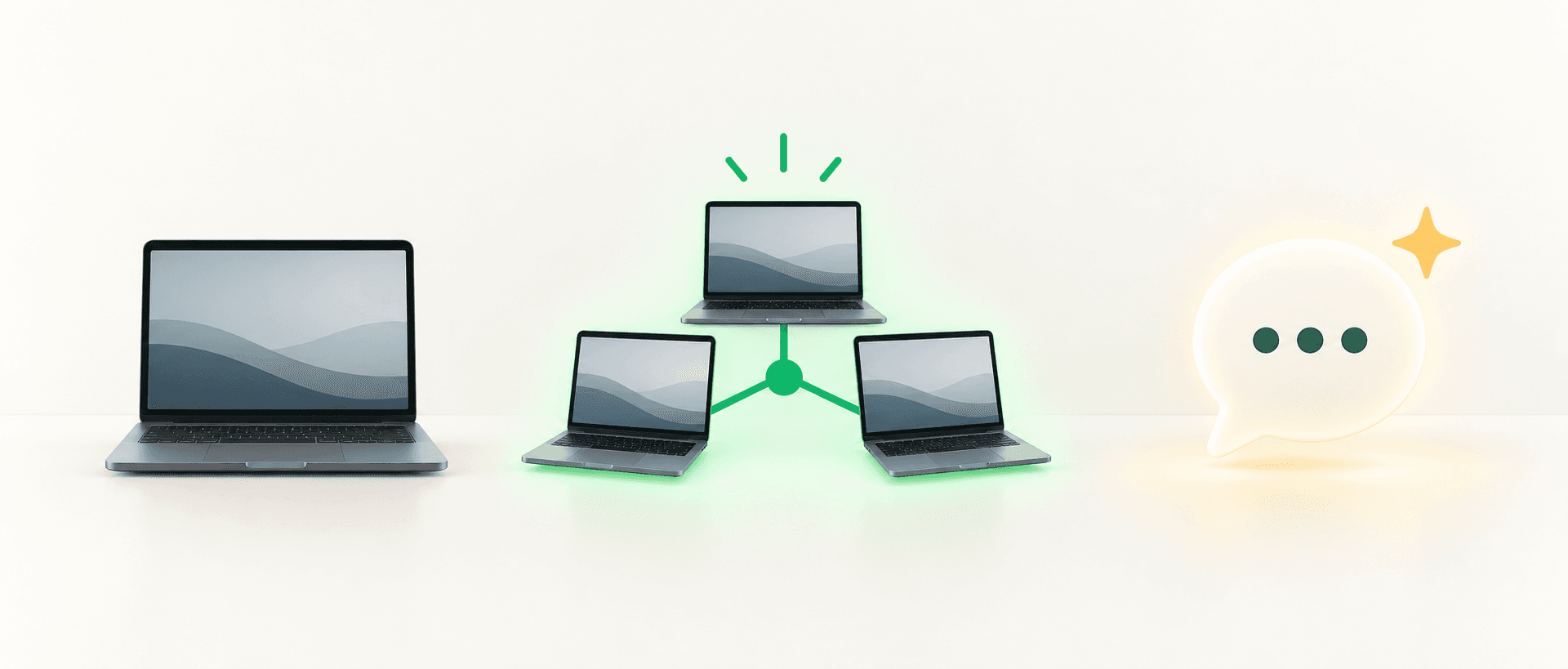
You have an idea and you need it built. Today you have three real choices: hire a freelancer, hire an agency, or use AI tools to build it yourself. This last option is often called vibe coding.
Each choice can be the right one. Each can also be the wrong one, and the wrong match can cost you months and a lot of money.
If you are comparing a freelance developer vs an agency for your startup, this guide is for you. We explain all three options in plain English, show when each one wins, and give you five questions to help you decide. We are a small studio, so we will be honest about where we fit and where we do not.
The short answer
- A freelancer is best when you want a custom product on a tight budget, and your scope is clear.
- An agency or studio is best when you need a team for design, building and support, and you do not want to manage the work day to day.
- Vibe coding is best for testing an idea or making a quick prototype, where a bug costs you little.
Many founders mix them. For example, they make a prototype with AI tools, then bring in a developer to build the real product. That is fine, as long as you plan it on purpose.
The three options in plain English
1. A freelance developer
A freelancer is one person you hire for your project. You usually speak to them directly, and they write the code themselves.
What they are good at: lower overhead, direct communication, and flexible terms. A strong freelancer can build a custom product at a fair price.
Where they fall short: the whole project rests on one person. If they get ill, get busy or disappear, you are stuck. A freelancer may also be strong at code but weaker at design or testing. Quality varies a lot from person to person, so checking their past work matters.
2. An agency or studio
An agency is a company with several people. A typical project might have a designer, one or more developers and someone who manages the work. A studio is usually a smaller version of this.
What they are good at: a team with different skills, a clear process, and support if one person is away. You get design, build, testing and launch in one place.
Where they fall short: a higher price, and sometimes a distance between you and the people doing the work. In some agencies, the person who sells the project is not the person who builds it. Large agencies can also be slower to change direction.
3. Vibe coding
Vibe coding means building software by describing what you want to an AI tool, which then writes the code for you. You may need little or no coding knowledge.
What it is good at: speed and low cost. You can get a working demo in hours or days, which is great for testing an idea or showing what you mean.
Where it falls short: the AI can write code that looks right but hides bugs, security gaps or poor structure. If you cannot read the code, you cannot tell. It can also become hard to change or grow as the product gets bigger.
Side by side
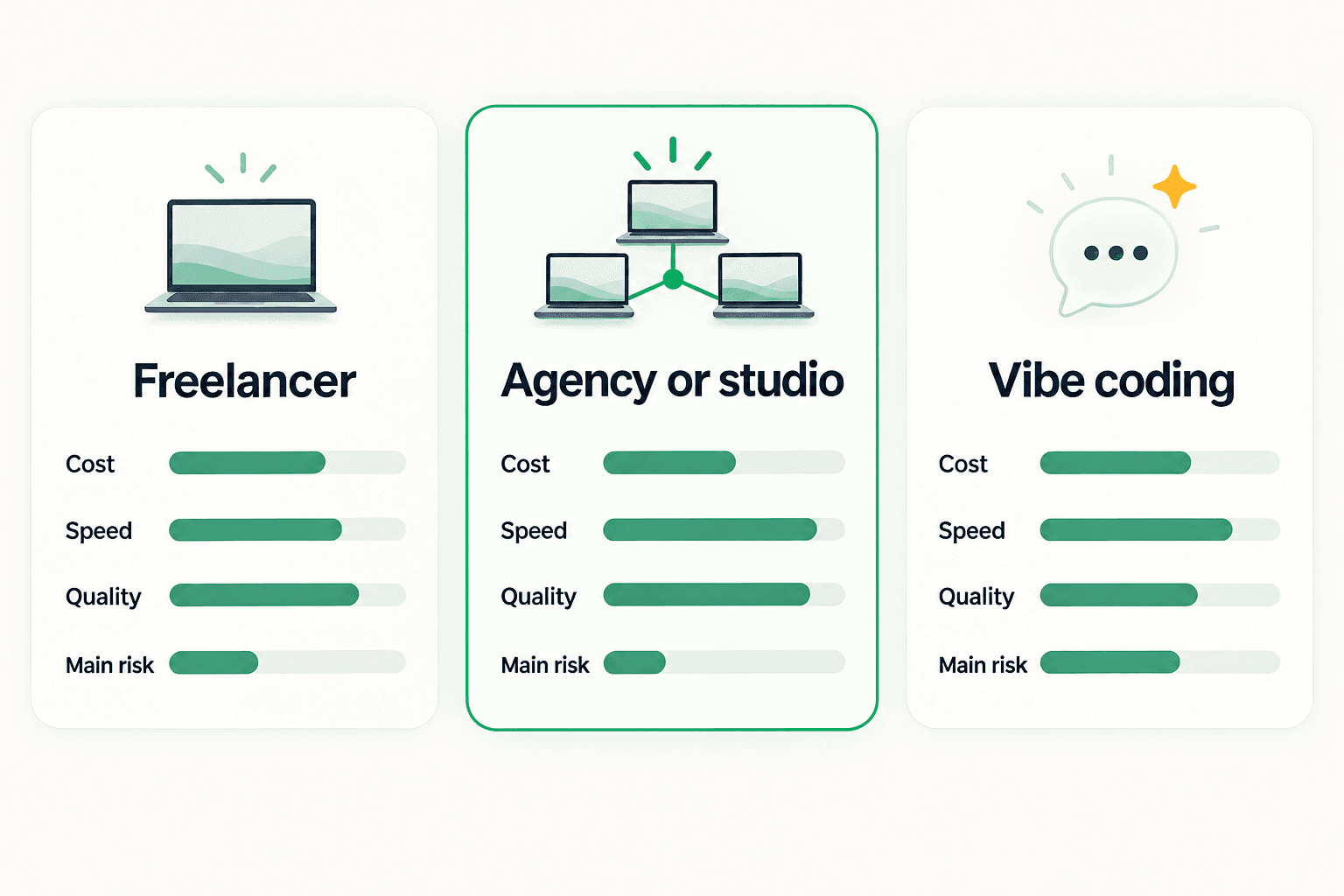
| Freelancer | Agency or studio | Vibe coding | |
|---|---|---|---|
| Cost level | Lower to medium | Medium to higher | Lowest |
| Speed to a first version | Weeks | Weeks | Hours to days for a demo |
| Quality and reliability | Depends on the person | Usually steadier, with a team and a process | Depends on how it is reviewed |
| Custom design | Depends on the person | Often included | Basic, unless you guide it well |
| Communication | Direct, one person | Through a manager, or direct in small studios | You are the one deciding everything |
| Main risk | One person is a single point of failure | Higher cost, and unclear who does the work | Hidden bugs and security gaps |
| Code ownership | You, if the agreement says so | You, if the agreement says so | Check each tool's terms |
| Support after launch | Ask and agree in advance | Often offered | None, unless you hire someone |
| Best for | Clear scope, tight budget | A team and ongoing support | Prototypes and low-risk tests |
There is no winner in every row. The best choice depends on what matters most for your project.
When a freelancer is the right choice
Choose a freelancer if:
- Your scope is clear and does not change every week.
- Your budget is tight and you want to stretch it.
- You can give feedback quickly and manage the work yourself.
- The project is small to medium, with one main area of work.
Before you sign, check:
- Past work you can open and use. Ask for live links, not just screenshots.
- A written scope in plain words.
- A small first milestone, paid on its own, so you can test how they work.
Our guide on how to hire a freelance developer lists more red flags to watch for.
When an agency or studio is the right choice
Choose an agency or studio if:
- You need design, building and testing together.
- You cannot manage the work day to day, and want someone to run the process.
- You want support after launch, and a team who knows the product.
- The product is complex enough that one person would be a risk.
Before you sign, ask who will actually do the work. Speak to that person. Ask whether the work is done in-house or passed to another company. A good team will answer this directly.
When vibe coding is enough, and when it is not
Vibe coding can be a smart first step. It works well for:
- Prototypes and demos that show people what you mean.
- Internal tools that only your own team uses.
- Learning whether people want your idea, before you spend real money.
Be careful when the product involves:
- Payments, where a bug can cost real money.
- Personal data, where a security gap can harm real people and bring legal trouble.
- Many users, where the code must be built to handle growth.
- Long-term use, where someone will have to maintain and change the code for years.
The key point: AI-written code can look fine and still be unsafe. Before real users and real money are involved, have an experienced developer review it. That review is far cheaper than fixing a problem after launch.

Mixing the options
You do not have to pick only one. Some common mixes:
- Vibe code a prototype, then hire a developer. You show your idea quickly, then a developer builds or reviews the real version.
- A freelancer plus a designer. You get a custom look and a custom build, each from a specialist.
- A studio for the MVP, then your own team later. The studio builds the first version and hands it over, and you hire in-house once you have users and proof.
Whichever mix you pick, agree in writing who owns what, and where the code lives.

5 questions to decide
Answer these honestly:
- How clear is my scope? If it is clear, a freelancer works well. If it is fuzzy, you may need a studio to help shape it, or an AI prototype to explore it first.
- How much budget do I have? A very tight budget points to a freelancer or to AI tools for a first test.
- What happens if the product has a bug? If a bug could lose money or leak data, do not rely only on vibe coding.
- Do I need support after launch? If yes, ask about it before you sign, with any option.
- How much time can I spend managing the work? Less time points to a studio. More time makes a freelancer easier.
Red flags for each option
- Freelancer: will not show live past work, refuses a written scope, wants all the money upfront, goes quiet for days.
- Agency: will not say who does the work, gives a vague price, pushes you to sign quickly, or leaves code ownership unclear.
- Vibe coding: nobody has reviewed the code, passwords or keys are stored in the open, payments are added without testing, or you cannot say how it works.
What every agreement should include
With any option that involves people, put these in writing:
- The code lives in your own GitHub account, and the agreement says you own it.
- The scope, the milestones and the dates.
- A handover: simple notes so another developer can take over.
- Payment in stages, tied to working results.
For exact wording, talk to a lawyer. Want a rough budget first? Try our free web app cost estimator, or read our guide to custom web app cost.
Our honest view
We are a small, founder-led studio, so we sit between a freelancer and a big agency. You speak directly to the person who builds your product, and there is a small team behind them. You own 100% of the code, and a focused MVP often takes 4 to 8 weeks. You can read more on our MVP development page.
We are not the right fit for every project. If AI tools or a freelancer are better for your stage and budget, we will tell you so. If you have no technical co-founder at all, our guide to your options when you have no tech partner covers the wider picture.
Frequently asked questions
Should a startup hire a freelancer or an agency for its MVP?
It depends on your budget, how clear your scope is, and how much support you need. A freelancer suits a clear scope on a tight budget. An agency or studio suits you if you want a team for design, build and support.
Is vibe coding good enough for an MVP?
It can be enough to test an idea or make a prototype. But before real users, payments or personal data are involved, an experienced developer should review the code for bugs and security gaps.
Is an agency always more expensive than a freelancer?
The hourly rate is usually higher. But the total cost depends on the scope, the rework and the quality of the work, so the cheaper rate is not always the cheaper result.
Can I mix a freelancer, an agency and AI tools?
Yes. For example, you can make a prototype with AI tools and then have a developer build the real version. Just agree who owns what, in writing.
What is the biggest risk of hiring a freelancer?
Everything depends on one person. If they get busy or leave, you can be stuck. Quality also varies, so check past work.
What are the risks of a vibe-coded MVP?
Hidden bugs, security gaps, and code that is hard to maintain or grow. These matter most when real users, money or data are involved.
Who owns the code?
It should be you, but only if it is written in your agreement. Ask for the code in your own GitHub account, and talk to a lawyer for contract wording.
How do I check a freelancer or an agency?
Ask for live links you can open, a written scope, a milestone plan, and talk to the person who will do the work. Start with a small first step.
Not sure who should build yours?
Tell us about your idea, and we will give you an honest view of which route fits, even if it is not us. Book a free 30-minute call, see how we build an MVP in 4 to 8 weeks, or get in touch directly.