
Two quotes for the same MVP can be very far apart. One is double the price of the other. Is the cheaper one a bargain, or a trap?
If you are a founder comparing MVP development cost in India with US prices, you have probably asked this already. The honest answer is: it depends, and the cheapest quote is not always the cheapest result.
In this guide we explain what makes up the cost of an MVP, why prices differ between India and the US, where the real savings come from, and what to check before you sign anything. We are a studio based in India, so we will be clear about where the US is the better choice too.
The short answer
- Cost is roughly hours times hourly rate, plus rework. That is the whole maths.
- Hourly rates in India are generally lower than in the US, so the same scope often costs less.
- A low rate does not guarantee a low bill. A vague scope, weak testing or a rebuild can wipe out the saving.
So do not ask only 'who is cheapest?' Ask 'who will deliver a working product, in the scope we agreed, without surprises?'
What an MVP cost is made of
Before you compare countries, know what you are paying for. The cost of an MVP comes from:
- Scope. How many features and screens you want. This is the biggest factor by far.
- Design. A simple, clean interface costs less than a fully custom design with animations.
- Connections to other tools. Payments, login, email, maps and AI features each add work.
- Who builds it. A solo developer, a small studio and a large agency all price differently.
- Testing and launch. Fixing bugs, setting up hosting and handing over the project take real time.
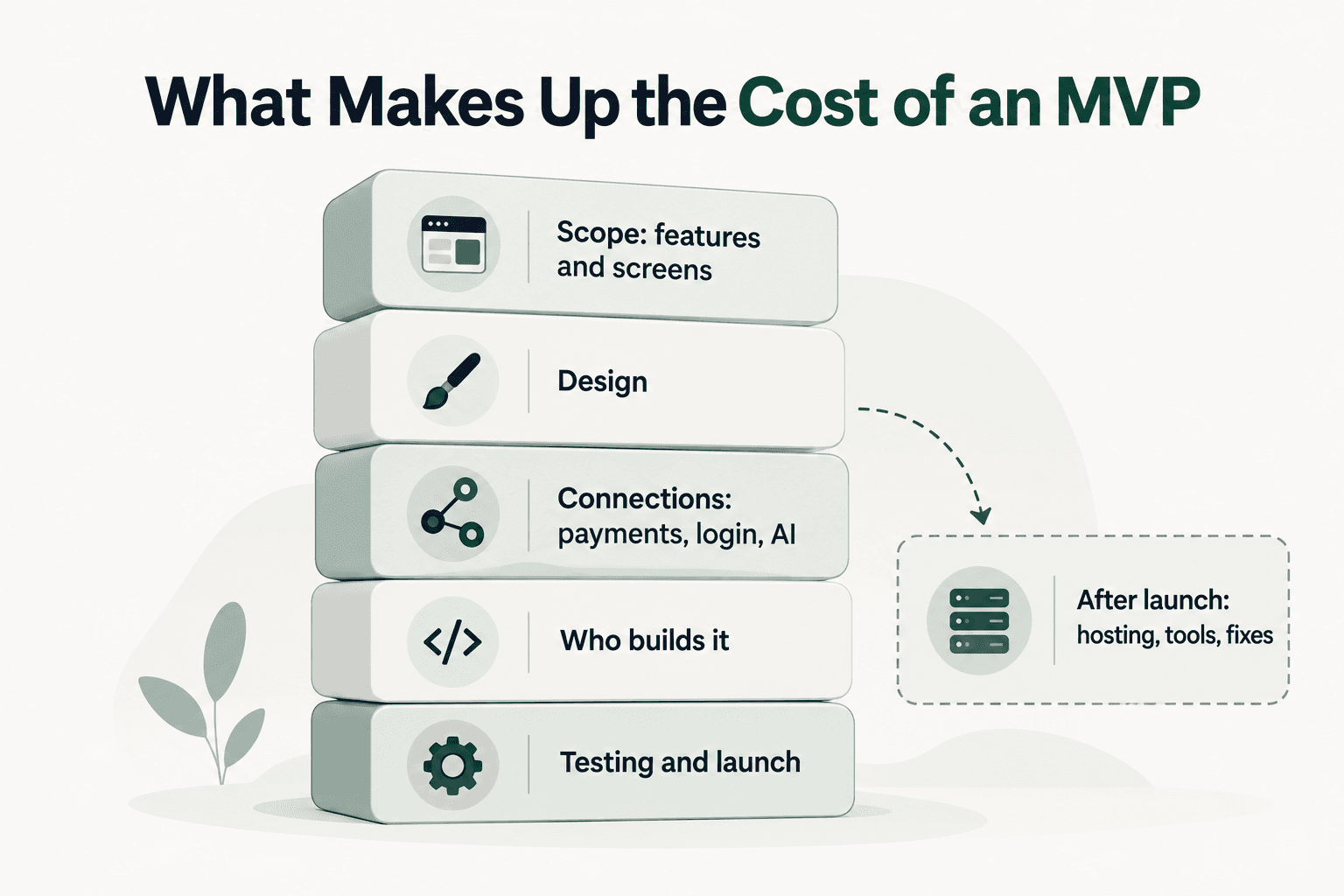
Then there are the costs after launch: hosting, paid tools, bug fixes and new features. Many founders forget these when they compare quotes.
Want a rough number for your own idea? Try our free web app cost estimator, or read our guide to custom web app cost.
Why prices differ between India and the US
The main reason is simple. Salaries and business running costs are lower in India, so the hourly rate a team needs to charge is lower. That is the gap you see in quotes.
It is not mainly about skill. In both countries you will find excellent developers and weak ones. The country on the invoice tells you very little about the quality of the work, so judge the team, not the flag.
India vs the US, side by side
| Factor | India | US |
|---|---|---|
| Hourly rates | Generally lower | Generally higher |
| Time zone | Roughly 9.5 to 13.5 hours ahead of US time zones | Same working hours as most US founders |
| Communication | Written updates, recorded demos and a few overlap hours | Easy live calls during your day |
| Contracts and legal | A cross-border agreement, so get ownership in writing | Local law that most US founders already know |
| Talent pool | Very large, with a wide range of skill levels | Large, usually at a higher cost |
| Best for | Tight budgets, focused MVPs, founders who are happy with weekly written updates | Products with strict US compliance needs, or founders who want daily live work together |
Notice that the US wins on some rows. This is not a case of one country being better. It is about which trade-offs suit your product and your way of working.
How the time zone works in practice
India is about 9.5 hours ahead of US Eastern time in summer and about 13.5 hours ahead of US Pacific time in winter. That sounds hard, but most teams handle it well:
- Agree on 2 to 3 overlap hours each week for live calls.
- Share a short written update every week.
- Use recorded demos, so you can watch progress at your own time.
- Keep decisions in writing, so nothing gets lost.
A bonus: when you send feedback at the end of your day, work can happen while you sleep.
The hidden costs of the cheapest quote
A low price often hides extra costs that show up later:
- Rework from a vague scope. If nobody wrote down what 'done' means, you will pay to fix misunderstandings.
- Extra charges for small changes. Some quotes look cheap, then charge for everything outside a very narrow list.
- Missing testing or handover. The build is 'finished', but nobody tested it, and nobody explains how to run it.
- Delays. Time is money for a startup, because every month of delay is a month without users.
- No code ownership. If the code is not clearly yours, a move to another team could be hard.
A very low price with a very short scope is a warning sign, not a bargain.
How to compare quotes properly
Put every quote side by side and check the same things in each:
- What is included? Design, testing, launch and handover should be named, not assumed.
- Milestones and dates. Work should be split into clear steps, each with a date and a result you can see.
- Who does the work? Ask to speak to the person who will build it. Some agencies pass projects to others.
- Code ownership. The code should live in your own GitHub account, and the agreement should say it is yours.
- Support after launch. Ask what happens when something breaks in week two.
- How changes are priced. Ask what happens if you want to add or remove a feature.
- Past work. Ask for live links you can open and use, not just screenshots.
Our guide on how to hire a freelance developer has more red flags to watch for.
A simple example
Here is a small example to explain the maths. These are round numbers for illustration only. This is not a price list and not a quote.
Imagine an MVP that needs about 400 hours of work. Call the lower hourly rate 'R'. Say the higher rate is twice that, '2R'.
- Team A, lower rate, with a clear scope: 400 hours at R = 400R.
- Team B, double the rate, with a clear scope: 400 hours at 2R = 800R.
- Team A again, but the scope was vague and half the work needed fixing: 600 hours at R = 600R. Still cheaper than Team B.
- Team A once more, but the whole product has to be rebuilt: 400 + 400 hours at R = 800R. The saving is gone, and you also lost months.
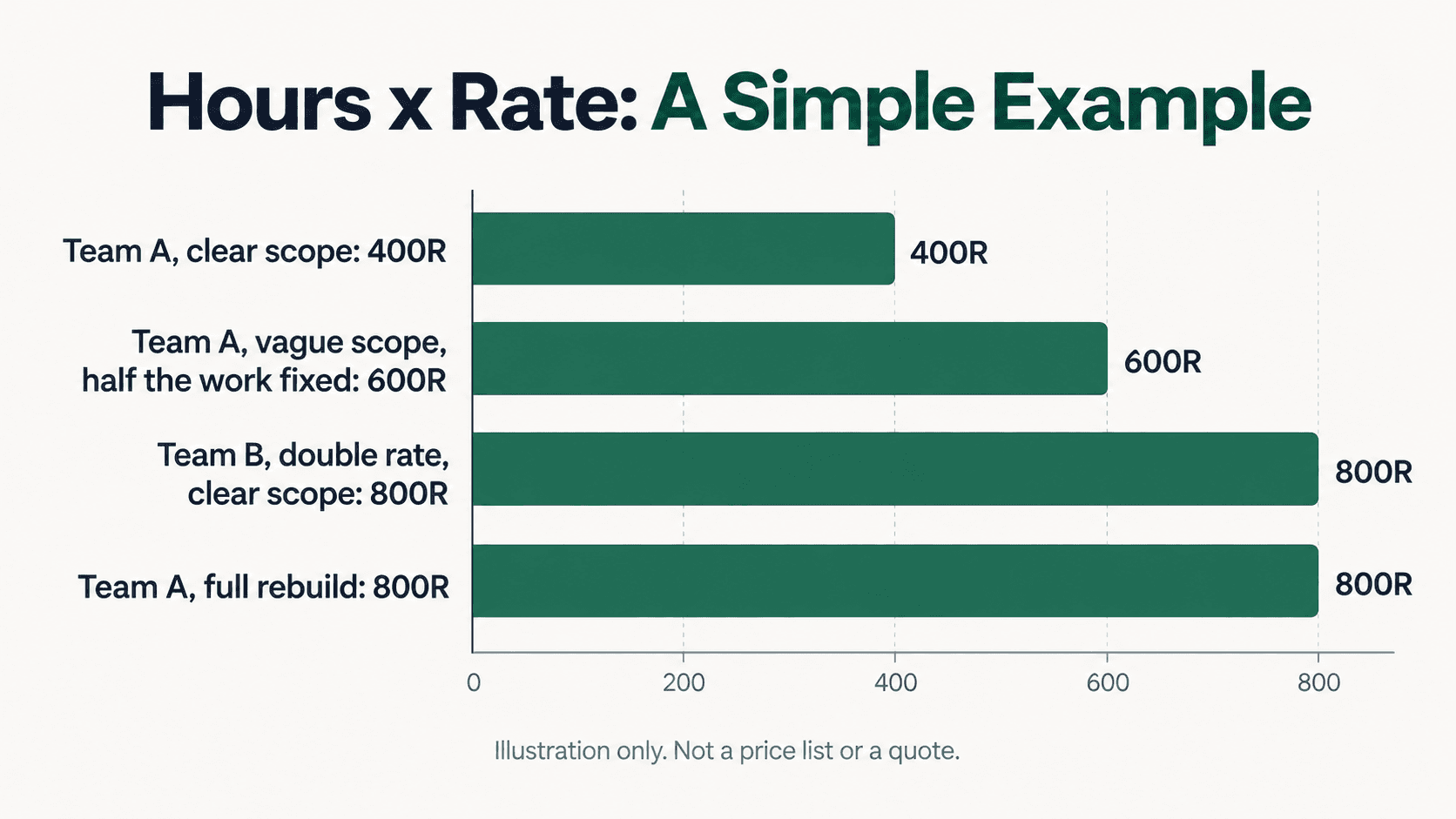
The lesson: a lower rate does save money, and it takes a lot of rework to cancel it. But a failed build wipes out the gain completely. That is why a clear scope and a trustworthy team matter more than the headline rate.
When the US makes more sense, and when India does
The US may be the better choice if:
- Your product has strict US legal or compliance needs and you want a local team who knows them.
- You want to work live with your team every day during your own hours.
- You need a very large team working at once.
India may be the better choice if:
- You have a tight budget and need to stretch it as far as possible.
- You are building a focused MVP with a clear scope.
- You are comfortable with weekly written updates and a few live calls.
Both can work well. The right choice depends on your product, your budget and your style of working.
How we price
We believe in being open about this, because trust matters more than any single quote.
Our MVP builds start from $1,000 for a focused first version. Smaller builds for Indian founders can start lower. In our cost guide, a lean MVP sits in the first budget tier, and the final price always depends on your scope. You own 100% of the code, there is no lock-in, and a typical MVP takes 4 to 8 weeks. We are a founder-led studio, so you talk to the person who builds your product. See more on our MVP development page and our India web development page.
Frequently asked questions
How much does it cost to build an MVP in India?
It depends on your features, design and who builds it. A small, focused MVP costs much less than a full product. At D Tech Solutions, MVPs start from $1,000 for a focused build, and the final price depends on your scope.
Is it cheaper to build an MVP in India than in the US?
Usually the hourly rate is lower in India, so the same scope often costs less. But the final cost depends on how clear the scope is and how much work needs to be redone.
Is the quality lower in India?
Quality depends on the team, not the country. Check past work you can open and use, ask for references, and speak to the person who will do the work.
How do I handle the time zone difference?
India is roughly 9.5 to 13.5 hours ahead of US time zones. Most teams agree on a few overlap hours, share weekly written updates and send recorded demos.
What hidden costs should I watch for?
Vague scope, extra charges for small changes, missing testing or launch work, no handover documents, and no clear ownership of the code.
Should I choose a fixed price or an hourly rate for an MVP?
A fixed price works well when the scope is clear and small. Hourly works better when you expect the scope to change. Many founders pick a fixed price with clear milestones.
Who owns the code when I hire a team in India?
It should be you, but only if it is written in your agreement. Ask for the code in your own GitHub account, and talk to a lawyer for the exact contract wording.
How can I pay safely?
Pay in stages that match working results, not everything upfront. Keep the code, the domain and the cloud accounts in your own name.
Want a clear number for your idea?
Try our free web app cost estimator for a quick range, or tell us what you want to build and we will give you an honest view. Book a free 30-minute call, or get in touch directly.