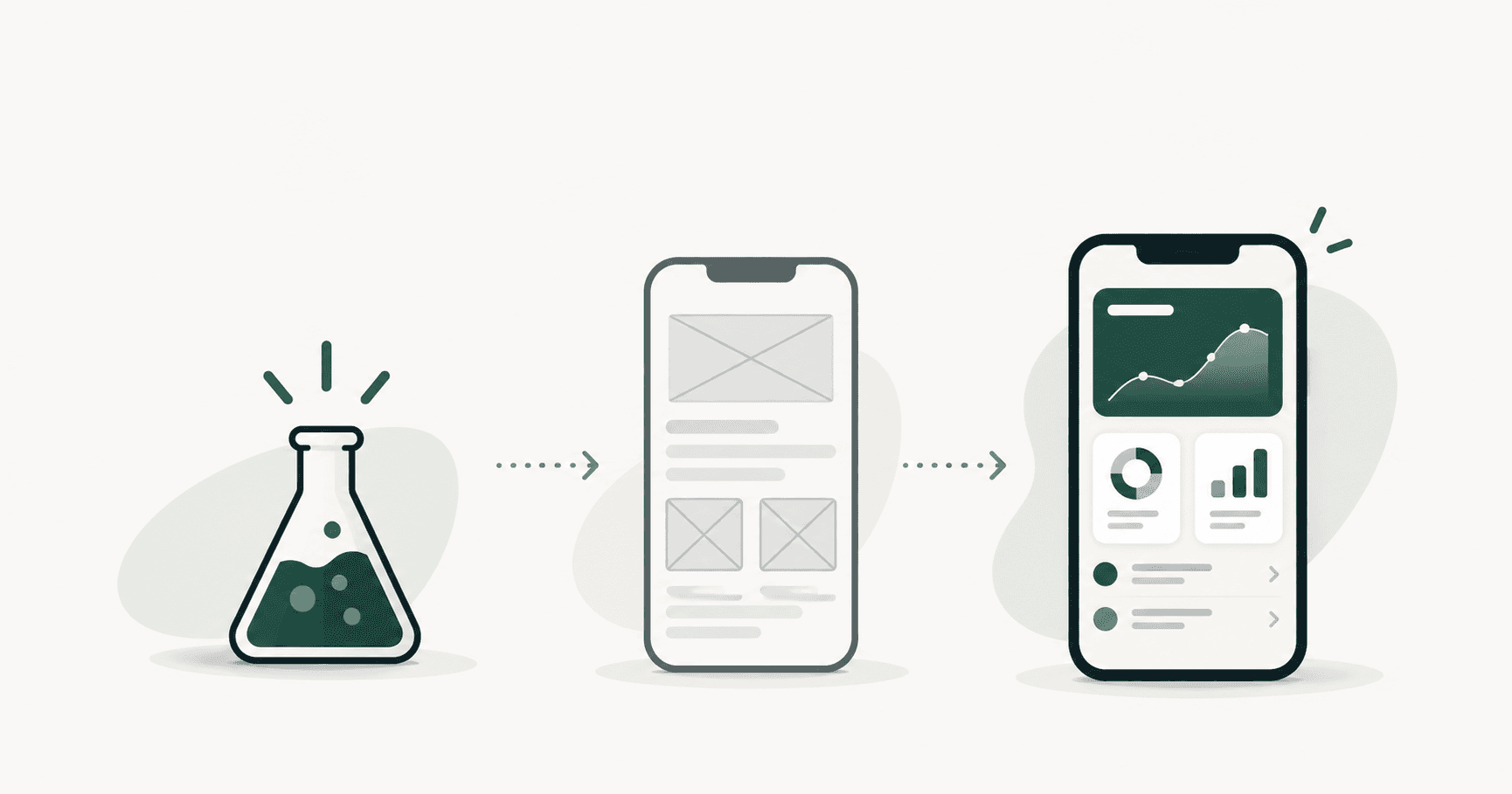
Your developer says you need a prototype. A friend says to build an MVP. An investor asks about your proof of concept. Are they all talking about the same thing?
No. The terms sound alike, and people use them loosely, but each one answers a different question. If you mix them up, you can spend money on the wrong thing at the wrong time.
In this guide we explain MVP vs prototype vs proof of concept in plain English. You will see what each one is, how they differ, and how to choose which one your startup needs first.
The short answer
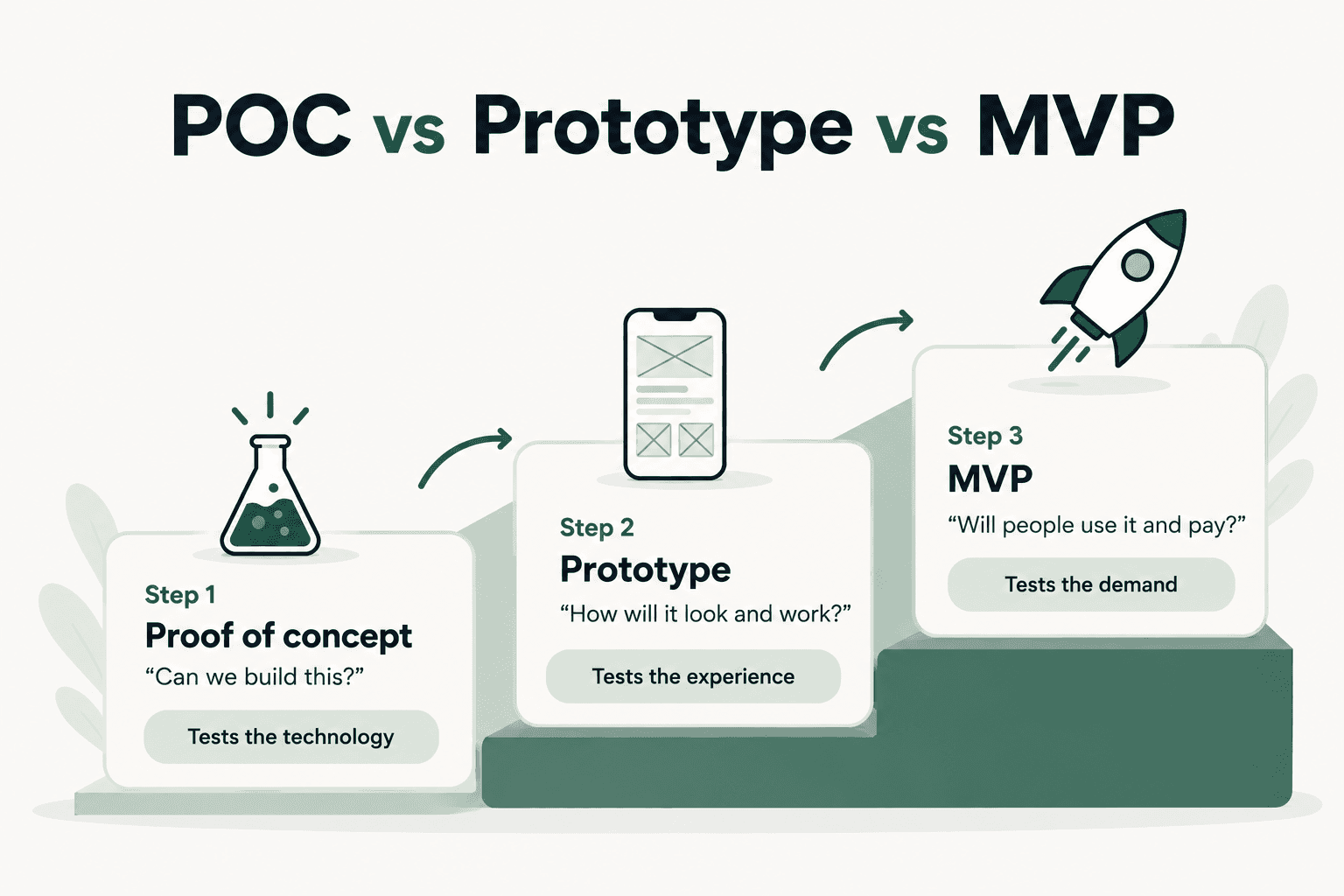
The easiest way to tell them apart is to ask which question each one answers.
| Question it answers | In one line | |
|---|---|---|
| Proof of concept (POC) | Can we build this? | A small test that shows an idea is possible |
| Prototype | How will it look and work for users? | A model of the product, often clickable but not real software |
| MVP | Will people use it and pay for it? | The smallest working product that real users can use |
If you remember only one thing: a POC tests the technology, a prototype tests the experience, and an MVP tests the demand.
What is a proof of concept?
A proof of concept, or POC, is a small experiment. Its job is to prove that an idea can work before you invest in building the whole product.
A POC usually focuses on the one part that feels risky or unusual. For example, imagine a startup that wants an AI feature to read documents and pull out key details. Before building an entire app, the team might test whether the AI can read sample documents accurately enough. That test is a proof of concept.
A few things to know about a POC:
- It is usually for your own team, or for a partner or investor, not for customers.
- It does not need to look good or have a nice design.
- The result is an answer, usually a yes, a no or a 'yes, but', not a finished product.
Many web app ideas use well-known technology, so they do not need a POC at all. A POC matters most when your product depends on something new or uncertain.
What is a prototype?
A prototype is a model of your product. It shows how the screens look and how a person moves from one step to the next. Often it is a set of clickable designs made in a design tool such as Figma.
Prototypes come in two main kinds:
- Low-fidelity: simple sketches or boxes on paper or screen. Quick and cheap, good for early ideas.
- High-fidelity: designs that look like the finished product, with real colours, text and buttons.
The big advantage is that you can put a prototype in front of real people and watch what happens. Do they understand it? Where do they get stuck? You learn this before you pay for any code, which is much cheaper than finding out after the build.
The limit is that a prototype is not working software. Buttons may look real, but nothing happens behind them. No data is saved, and no payment goes through.
What is an MVP?
MVP stands for minimum viable product. It is the smallest version of your product that real people can actually use and that solves one real problem.
Three points matter here:
- It works. Users can sign up, use the main feature and, if relevant, pay. It uses real data.
- It is small. It has only the features needed to test your main idea. Everything else waits.
- It is not sloppy. 'Minimum' means a small number of features, not low quality. A product that breaks or loses data teaches you nothing.
The goal of an MVP is to learn. Do people want this? Will they come back? Will they pay? You need those answers before you spend months building more.
We cover this in more depth on our MVP development page, and our guide on how to build an MVP without a technical co-founder shows the routes you can take.
MVP vs prototype vs POC, side by side
| Proof of concept | Prototype | MVP | |
|---|---|---|---|
| Main question | Can it be built? | Will users understand it? | Will people want and pay for it? |
| Who uses it | Your team, partners, investors | Test users, your team, investors | Real users |
| Is it working software? | Only the risky part | No, usually a model | Yes |
| Built to launch? | No | No | Yes |
| Time | Usually the shortest | Short | Longest of the three. A focused MVP often takes 4 to 8 weeks |
| Cost level | Low | Low to medium | Medium to higher |
| Best used when | A key technical part is uncertain | You want to test the design before building | You are ready to test demand with real users |
Notice that the three are not steps of the same ladder in every project. They are tools. You pick the one that fits your biggest question.
Which one do you need?
Ask yourself: what is the scariest question about my idea? That question tells you where to start.
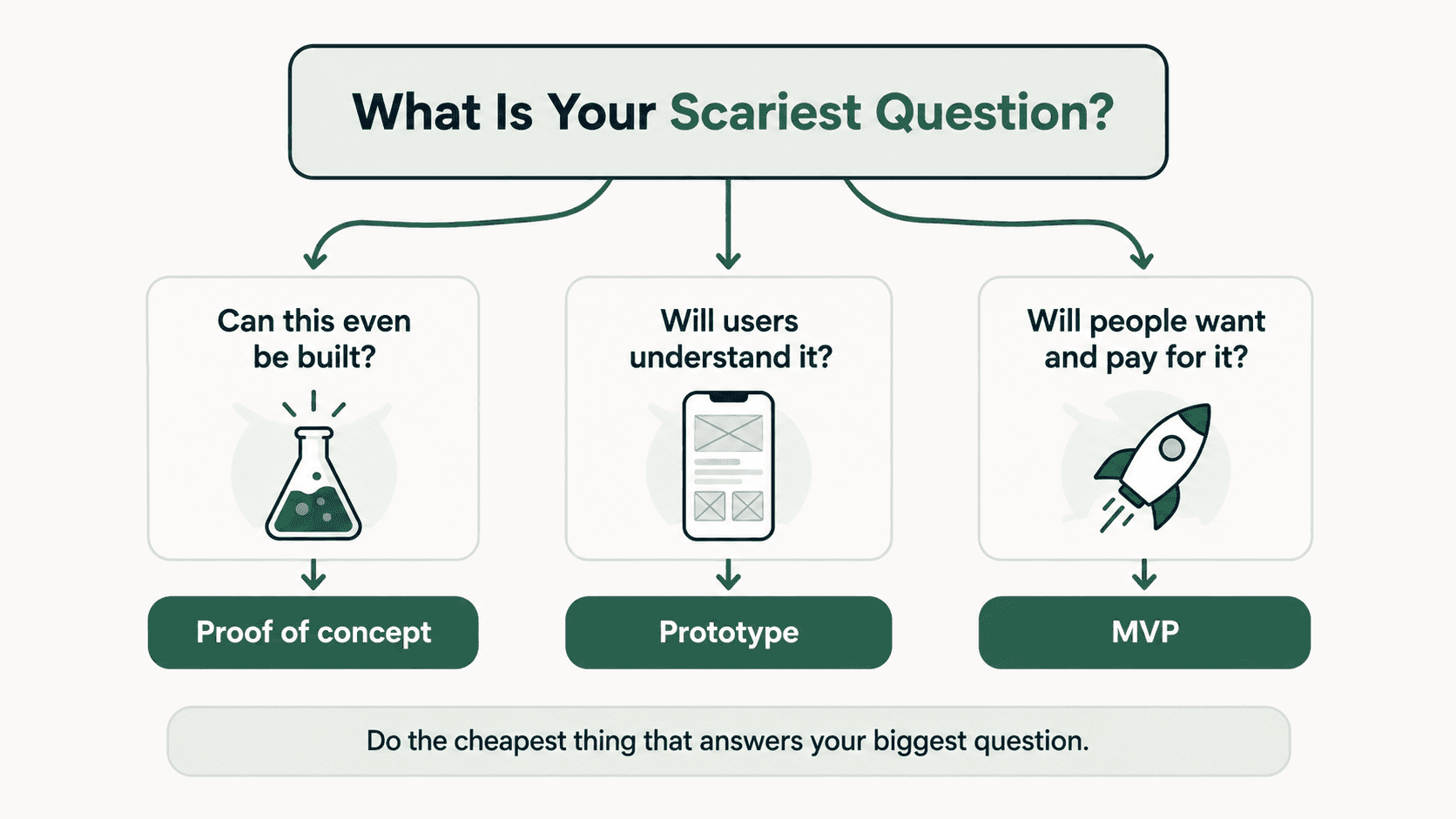
- 'Can this even be built?' Start with a proof of concept. This is common when your idea relies on new AI, hardware or a tricky integration.
- 'Will users understand how to use it?' Start with a prototype. This is common when the flow is new or has many steps.
- 'Will people actually want and pay for this?' Go to an MVP. A prototype can help first, but only real use can answer this.
A good rule: do the cheapest thing that answers your biggest question. If a sketch can answer it, do not build software. If only real users can answer it, build the MVP.
Do you need all three?
Usually, no.
- Many web app startups go straight from a prototype to an MVP. The technology is well known, so there is nothing to prove.
- Products with an uncertain technical part, such as a new AI feature, may do a POC, then a prototype, then an MVP.
- Very simple ideas sometimes skip the prototype and build a small MVP directly.
Doing all three can be a waste if the earlier steps do not answer a real question. Each step should have a reason.
Not sure what a build will cost? Try our free web app cost estimator, or read our guide to custom web app cost.
Common mistakes
- Calling a prototype an MVP. A clickable design is not a product. Users cannot really use it, so it cannot test demand.
- Showing a POC to customers. A POC is rough on purpose. Customers will judge it as a finished product.
- Building too much. An MVP with 20 features is no longer minimal. Cut until only the core remains.
- Skipping user tests. All three tools exist to learn. If you do not talk to real people, you learn nothing.
- Expecting prototype code to become the product. Quick test code is usually not safe or clean enough for real users. Plan to build the real thing properly.
Other terms you will hear
- Wireframe: a simple black-and-white layout of a screen. It shows structure, not looks.
- Mockup: a detailed picture of how a screen will look, but it is not clickable.
- Pilot: a trial run of a product with a small group of real customers.
- Beta: a nearly finished product shared with a larger group to find problems before the full launch.
- MLP (minimum lovable product): an MVP with extra polish, so users enjoy it and not only tolerate it.
How we handle this
Our process follows the same logic. We start with discovery, to find your biggest question. Then we move to planning and design, where you see clickable designs and approve every screen before we write code. After that we build and test in weekly steps, then launch and support. You own 100% of the code, and a focused MVP often takes 4 to 8 weeks.
The point is to spend your money on the thing that answers your biggest question first.
Frequently asked questions
What is the main difference between an MVP and a prototype?
A prototype shows how a product will look and work, but it is not real software. An MVP is a small, working product that real users can use.
Is a proof of concept the same as an MVP?
No. A proof of concept checks whether something can be built. An MVP tests whether people want it. A POC is usually for your team, and an MVP is for real users.
Which should I build first?
It depends on your biggest risk. If you doubt it can be built, start with a proof of concept. If you doubt that users will understand it, build a prototype. If you doubt that people want it, build an MVP.
Can I show a prototype to investors?
Yes, many founders do. But a working MVP with early users is often stronger proof. It varies by investor.
Can I turn a prototype into an MVP?
You can often reuse the design. The code from a quick prototype is usually not good enough for a real product, so plan to build the MVP properly.
How long does each one take?
A POC and a prototype are usually quicker than an MVP. A focused MVP built by a small team often takes 4 to 8 weeks.
Is an MVP a cheap, rough product?
No. It is the smallest useful product, with only the key features, but it should still work well.
What is an MLP?
An MLP is a minimum lovable product. It is an MVP with extra polish, so users enjoy using it, not just tolerate it.
Not sure which one you need?
Tell us about your idea, and we will help you find your biggest question and the cheapest way to answer it. Book a free 30-minute call, see how we build an MVP in 4 to 8 weeks, or get in touch directly.