You have the idea. You have the drive. But you do not have anyone to write the code. Do you wait for a technical co-founder to show up?
No, you do not have to. Many founders get their product built without one. The hard part is not whether you can build an MVP without a technical co-founder. The hard part is choosing the right way to do it, because the wrong choice costs months and money.
In this guide we compare four real options, give you a 6-step plan, and show the mistakes that trip up first-time founders. We are a small studio, so we are one of the options, and we will point that out where it matters.
The short answer
You have four main routes:
- No-code tools for simple ideas you want to test fast.
- AI coding tools for quick prototypes and early experiments.
- A freelance developer for a custom product on a tight budget.
- A small studio for a custom product when you want a team behind it.
For a simple idea, start with no-code or AI tools. For anything with payments, user data or custom logic, bring in an experienced developer. A focused MVP built by a small team often takes 4 to 8 weeks.
Do you really need a technical co-founder?
A technical co-founder gives you real things: shared risk, someone who cares as much as you do, and long-term ownership of the product. That is valuable.
But it also has a price. You give away equity, and you may spend months searching for the right person before you write a single line of code. Many ideas die during that search.
Here is the key point. What you need is technical ownership, meaning someone who is responsible for how the product is built and who makes sure you own it. That person does not have to be a co-founder on day one. You can get technical ownership by hiring a developer or a studio, and you can look for a co-founder later, once you have users and proof.
4 ways to build an MVP without a technical co-founder
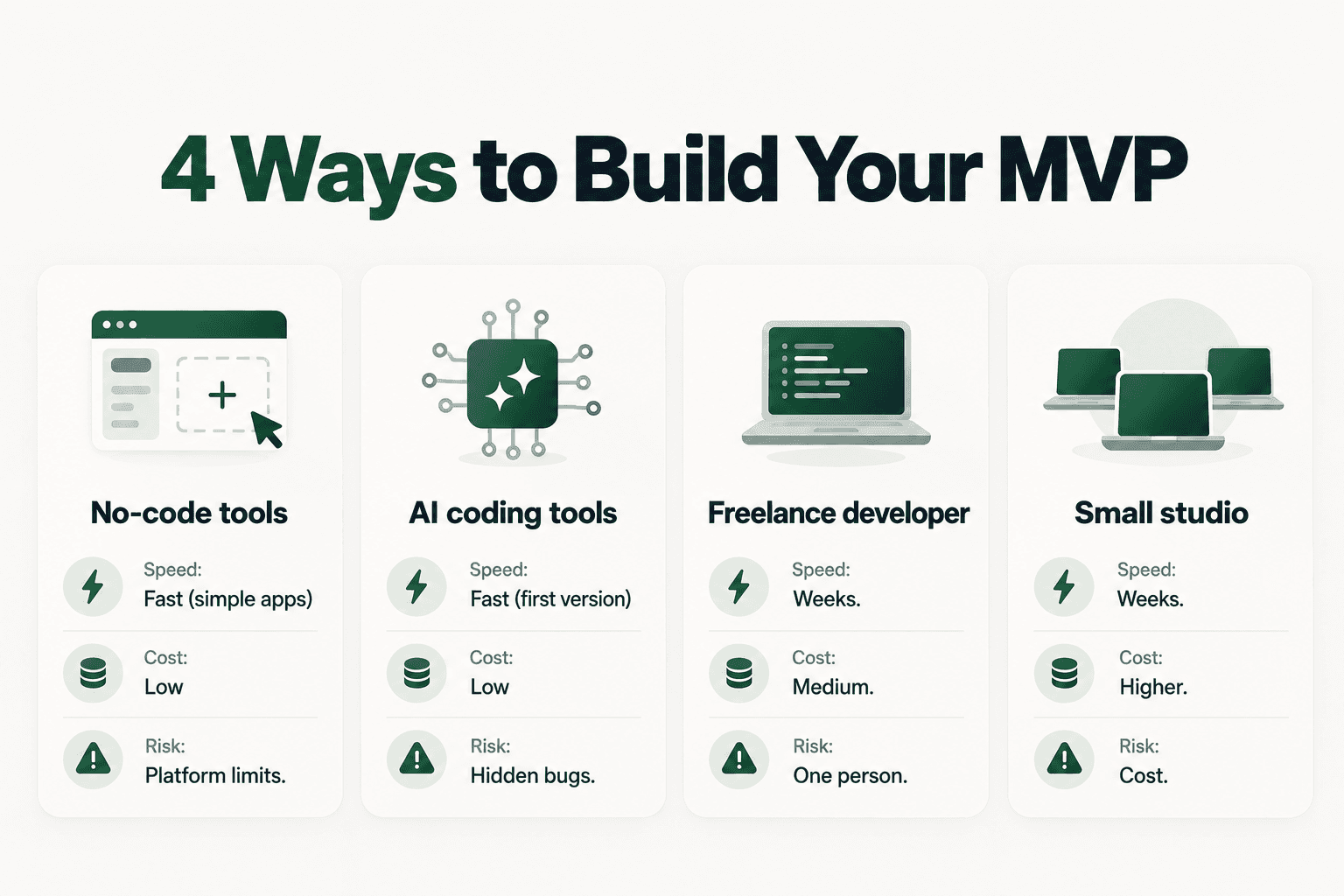
| Way | Best for | Speed | Cost level | Main risk | Who owns it |
|---|---|---|---|---|---|
| No-code tools (such as Bubble or Glide) | Simple apps: forms, listings, basic workflows | Fast for simple products | Low | Platform limits, and moving away may mean a rebuild | You own the app on the platform, not the code |
| AI coding tools | Quick prototypes and early tests | Fast for a first version | Low | Hidden bugs and security gaps | Check each tool's terms |
| Freelance developer | A custom product on a tight budget | Weeks | Medium | One person is a single point of failure, and quality varies | You, if your agreement says so |
| Small studio or agency | A custom product with a team behind it | Weeks | Higher | Cost, and you must check who actually does the work | You, if your agreement says so |
1. No-code tools
No-code tools let you drag and drop screens and connect data without writing code. They are great for testing whether people want your idea. You can often get something live in days.
The limit appears later. When you need custom logic, many users, complex payments or a special design, you can hit a wall. If your idea works, plan for a possible rebuild.
2. AI coding tools
AI app builders can turn a text description into a working prototype very quickly. For a clickable demo or a small experiment, they are a real option now.
Be careful before real users and real money are involved. Security, payments, user data and fixing bugs still need an experienced person to review the work. A prototype that looks fine can hide serious problems.
3. A freelance developer
A good freelancer can build a custom product at a fair price, and you talk to the person who writes the code. This is a strong route for many early founders.
The risk is that everything depends on one person. If they get busy or leave, you can be stuck. Quality also varies a lot, so checking their past work matters. Our guide on how to hire a freelance developer shows what to look for.
4. A small studio or agency
A studio gives you a team: someone for design, someone for code and someone to manage the work. It costs more than a freelancer, but it lowers the single-person risk.
This is the group we belong to, so take our view with that in mind. Whichever you choose, ask who will actually do the work, because some agencies pass projects to others. Learn more about how we work on our MVP development page.
6 steps to get your MVP built
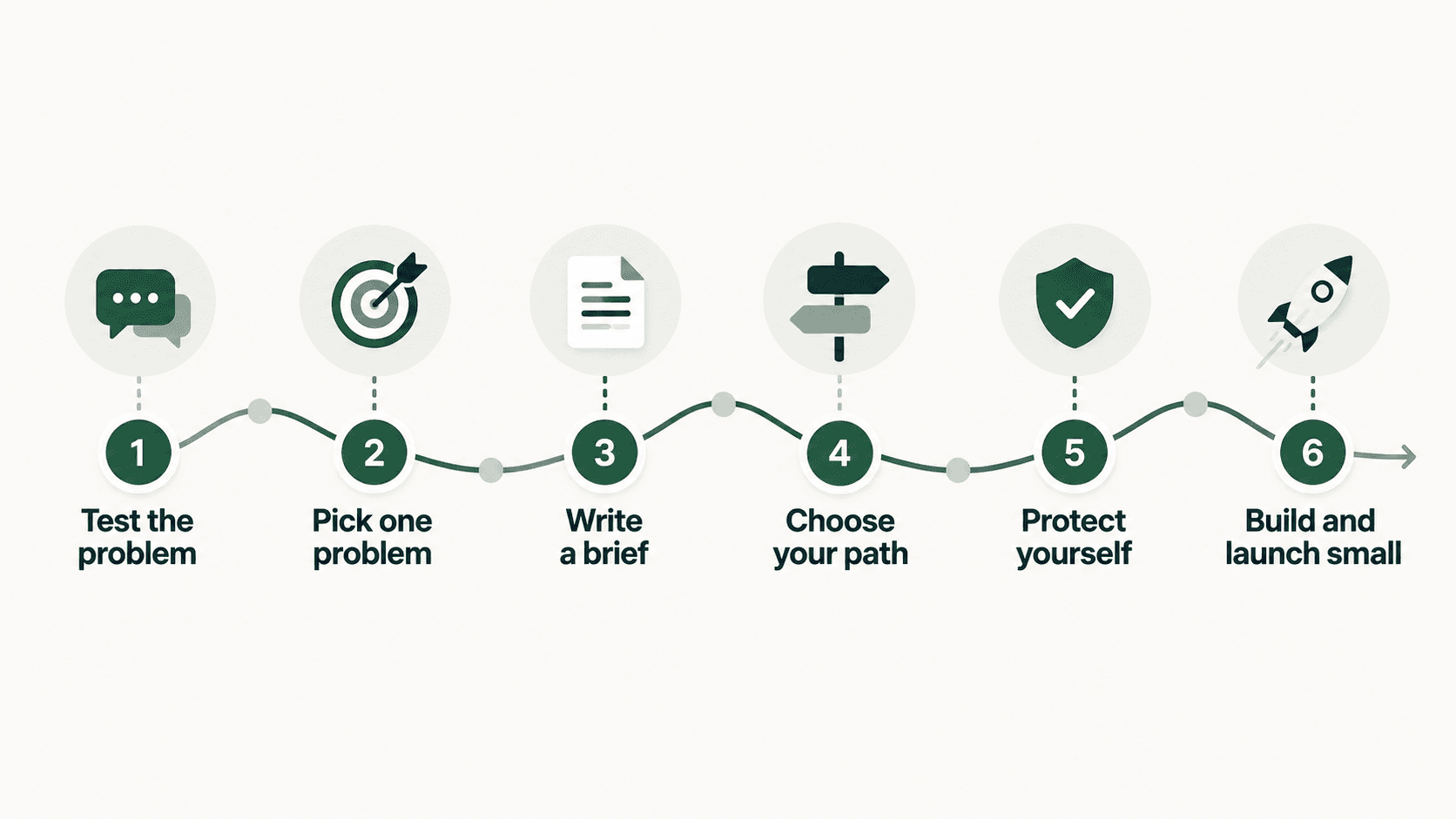
Step 1: Test the problem before you build
Talk to about 10 people who might use your product. Ask how they handle the problem today and what annoys them. If nobody cares, you have saved yourself a lot of money. If they do care, you now have your first users and real words to use in your product.
Step 2: Pick one problem and one type of user
Most MVPs fail by trying to do too much. Choose one main problem for one type of user. Write it in a single sentence. Everything that does not help that sentence can wait for version two.
Step 3: Write a one-page brief
Write down what the product does, who it is for, the 3 to 5 main features, and what a good first version looks like. A clear brief makes quotes fairer and builds faster, because nobody has to guess.
Step 4: Choose your path
Use the table above. If your product is simple and you only need to learn, try no-code or an AI tool. If it needs payments, accounts, custom rules or will hold other people's data, go with a developer or a studio. If you are unsure about cost, try our free web app cost estimator and read our guide to custom web app cost.
Step 5: Protect yourself
This step is the one founders skip, and it matters most when you do not have a technical person on your side. Before work starts:
- Make sure the code lives in your own GitHub account.
- Register your domain and cloud accounts in your own name.
- Get ownership of the code in a written agreement. A lawyer can check the exact wording.
- Ask for simple documentation, so another developer can take over later.
Step 6: Build in small steps and launch to a few users
Ask for working updates every week, so you can see progress and change direction early. Aim to launch to a small group first, maybe 10 to 20 people, not the whole world. Real feedback is worth more than any extra feature. Our guide on working with a developer as a non-technical founder helps you give feedback that actually helps.
How to pick and check a developer
You do not need to read code to judge a developer. Look for these signs:
- Past work you can open and use. Ask for live links, not only screenshots.
- A written scope. They should explain what you will get, in plain words.
- A step-by-step plan. Work should be split into clear milestones with dates.
- Direct access. You should speak to the person who will do the work.
- A small first step. Start with a short, paid first milestone before you commit to the whole project.
If they cannot explain things simply, treat that as a warning sign.
Mistakes to avoid
- Building too much. Every extra feature adds time and cost. Launch with the smallest useful version.
- Paying everything upfront. Pay in stages, linked to working results.
- No written code ownership. Without it, you may not fully own what you paid for.
- Skipping user tests. Do not build for months before one real person tries it.
- Choosing only by lowest price. A cheap build that must be redone costs more in the end.
What if you still want a co-founder?
That is fine. A technical co-founder can be a great long-term partner. Here is a gentler route that many founders use:
- Get the MVP built first. Real users and early proof make it easier to attract a good co-founder later.
- Bring in a technical advisor. A part-time advisor or fractional CTO can guide your choices without full-time cost.
- Be clear on roles and equity. If you do find a co-founder, agree on roles and use a vesting plan, which usually gives equity over several years. Have a lawyer prepare the paperwork.
Frequently asked questions
Can I build an MVP without a technical co-founder?
Yes. Common routes are no-code tools, AI coding tools, or hiring a freelancer or studio. The best fit depends on how complex your product is and how much risk you can take.
Is no-code enough for an MVP?
For simple products like forms, listings or basic workflows, often yes. Limits show up when you need custom logic, many users or complex payments. If it works, you may need to rebuild later.
Can AI coding tools replace a developer?
They can help you test an idea or make a clickable prototype quickly. But security, payments, user data and bug fixing still need an experienced person before real users and real money are involved.
How much does it cost to build an MVP without a co-founder?
It depends on your features, your design and who builds it. There is no fixed price. Try our free cost estimator for a rough range, or read our cost guide.
How do I find a developer I can trust?
Check past work you can open and try, ask for a written scope, talk to the person who will actually do the work, and start with a small paid first step.
Do I need a technical co-founder to raise money?
It varies by investor. Many like to see strong technical ownership, but a working product, early users and a clear build plan can matter just as much. A technical advisor can also help.
Who owns the code if I hire someone?
It should be you, but only if it is written in your agreement. Ask for the code to live in your own GitHub account, and talk to a lawyer for the exact contract wording.
How long does it take to build an MVP?
A focused MVP built by a small team often takes 4 to 8 weeks. Simple no-code products can be faster.
Have an idea and no developer?
Tell us what you want to build, and we will tell you honestly which route fits, even if it is not us. Book a free 30-minute call, see how we build an MVP in 4 to 8 weeks, or get in touch directly.