
You have a solid idea. Maybe it's a client portal, a SaaS product, or an internal tool that your team desperately needs. Then you ask a developer or three what it'll cost, and you get answers ranging from $3,000 to $300,000. That gap isn't a mistake. It reflects how wildly different custom web app cost can be depending on what you're building, who builds it, and where they're located.
This post won't give you a single magic number. Instead, it gives you a working framework: what drives cost, what you can expect at each budget tier, how to avoid common traps, and what a realistic project scope looks like. By the end, you'll be able to have a real conversation with a developer not a guessing game.
Want a faster gut-check first? Run your project through the free cost estimator and get a rough range in under two minutes, no email required.
What Actually Drives the Cost of a Custom Web App
Before any pricing makes sense, you need to understand the inputs. Costs aren't arbitrary. They break down into a handful of levers you can actually control.
Scope and feature complexity is the biggest driver. A simple CRUD app with user authentication and a dashboard is not the same as a multi-tenant SaaS platform with role-based permissions or Stripe billing integrations and real-time data. Each feature adds design time, development time, and testing time.
Team type and location is the second-biggest variable (see Clutch for rate trends). Here's the rough hourly rate landscape in 2026:
| Team Type | Hourly Rate (USD) |
|---|---|
| US/UK/AU agency | $120 – $250/hr |
| European agency | $80 – $150/hr |
| Indian freelancer or agency | $25 – $75/hr |
| Solo specialist (India, niche) | $40 – $90/hr |
| No-code / low-code hybrid | $50 – $100/hr |
Tech stack matters more than most founders expect. A Next.js (React), Prisma + PostgreSQL app costs less to build and maintain than a microservices architecture with custom DevOps. Don't over-engineer an MVP.
UI/UX design is often underbudgeted. Custom UI from scratch costs more than using a component library. Plan for at least 15–20% of your budget going to design.
Integrations Stripe, Twilio, third-party APIs, CRMs each adds days of work.
Post-launch costs: hosting, maintenance, bug fixes, and feature iterations are ongoing. Budget for them.
Cost Tiers: What You Get at Each Budget Level
Rather than a single estimate, think in tiers. Here's a realistic breakdown (see the full service and pricing breakdown for D Tech's current starting prices by project type):
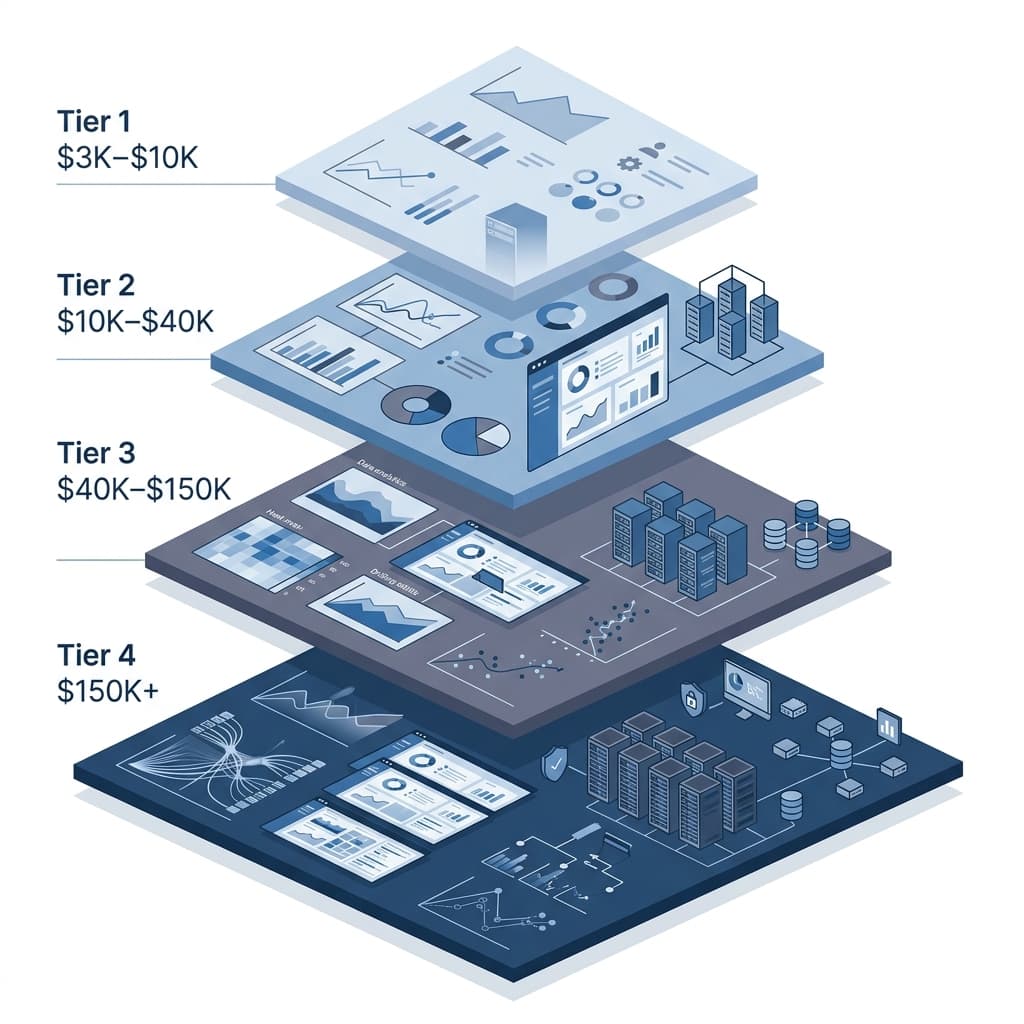
Tier 1: $1,000 – $10,000 Lean MVP
Best for: validating an idea, landing a first client, or building an internal tool.
- 4–8 weeks of development
- 1 or 2 core features only
- Simple UI using a component library (no custom design system)
- Basic auth, database, and deployment
- Usually a solo developer or small offshore team
What you won't get: polished UX, complex business logic, third-party integrations, or scalable architecture. That's fine this tier is for learning, not scaling. This is exactly the tier D Tech's MVP development service is built for, with builds starting at $1,000.
Tier 2: $10,000 – $40,000 Production-Ready V1
Best for: early-stage SaaS, client-facing portals, marketplace MVPs.
- 6–16 weeks of development
- Core feature set with proper UX
- User authentication, roles, billing (e.g. Stripe)
- 1–2 third-party integrations
- Mobile-responsive, deployed on a managed cloud platform
- Small team: lead developer + designer, or experienced full-stack agency
This is the sweet spot for most funded startups and bootstrapped founders who've validated demand.
Tier 3: $40,000 – $150,000 Scalable Product
Best for: Series A+ startups, enterprise tools, regulated industries (fintech, healthtech).
- Full product team for 3–6 months
- Advanced features: real-time data, complex permissions, analytics dashboards
- Custom design system, accessibility compliance
- Robust test coverage, CI/CD pipeline, monitoring
- Likely involves a small agency or 3–5 person team
Tier 4: $150,000+ Enterprise-Grade
This is bespoke software at scale multi-region deployments, dedicated security reviews, compliance (SOC 2, HIPAA), and long-term team contracts. Most startups don't need this on day one.
A Realistic Scenario: SaaS Client Portal Built by D Tech
Consider a US-based logistics company that needs a client-facing portal: customers can log in, track shipments, upload documents, and generate invoices. Nothing exotic but nothing trivial either.
Here's how that project breaks down:
Features scoped:
- Authentication + role-based access (client vs. admin)
- Shipment tracking dashboard with status updates
- Document upload (S3-backed)
- Invoice generation (PDF export)
- Basic email notifications
Estimated timeline: 8–10 weeks
Estimated cost with D Tech: $12,000 – $18,000
That same project with a mid-market US agency would likely run $45,000 – $70,000. The difference isn't quality it's overhead, location, and team size. D Tech operates as a lean, senior-led solo agency based in India, which means clients get a direct line to the person writing the code, without account manager layers or inflated estimates.
The tech stack used would be Next.js (React), Prisma + PostgreSQL, AWS S3, and Stripe modern, maintainable, and easy to hand off or extend.
This is the kind of scoping conversation D Tech has before quoting anything. There are no discovery fees, no vague "starting from" numbers.
5 Mistakes That Blow Up Web App Budgets
Most projects don't fail because of bad developers. They fail because of avoidable planning mistakes. Here are the most common ones:
1. Scoping too wide from day one. Founders list every feature they've ever imagined, then wonder why the quote is $80,000. Start with the smallest version that delivers value to a real user. Ship it. Then add.
2. Skipping the technical spec. A vague brief produces a vague (and low) quote that balloons post-kickoff. Insist on a written scope with feature list, user flows, and acceptance criteria before any work starts.
3. Choosing on price alone. The cheapest quote often comes with the highest hidden costs rework, delays, and eventually a rewrite. Look at portfolios, ask for references, and check whether the developer actually understands your domain.
4. Underestimating ongoing costs. A $15,000 build can cost $500–$2,000/month to maintain, host, and support. If your developer disappears after launch, you're stuck. Factor in a retainer or a handoff plan.
5. Not budgeting for design. "We'll use a template" often ends with a product that users don't trust. For client-facing apps, design is not optional—it's conversion infrastructure (read about why poor design and UX lose customers).
Conclusion
Custom web app cost in 2026 depends almost entirely on what you're building and who's building it. A lean MVP can be done well for under $15,000. A production-grade SaaS typically lands between $20,000 and $60,000. Enterprise software goes higher, but most founders reading this aren't there yet.
The smarter question isn't "how much?" it's "what's the smallest version that proves this works?" Answer that first, then find a builder who'll give you a straight number. If you are planning a first version, our MVP development page shows how we scope and ship one in 4–8 weeks. Comparing quotes across countries? See MVP development cost in India vs the US.
If you're ready to scope your project, D Tech's approach to custom web and SaaS development is built for high-ticket clients across the US, UK, EU, and Australia. No fluff, no middlemen just clean code and honest timelines. Book a free discovery call at dtechsolutions.tech/contact.