You have a SaaS idea. You talk to two developers. One says, 'Use Next.js.' The other says, 'Laravel will be faster.' Both sound sure.
The good news is that both can be right. For most SaaS products, either one will work. The better question is which one fits your product, your budget and the person who will build it.
In this guide we compare Next.js vs Laravel for SaaS in plain English. You will get a side-by-side table, clear rules for when each one wins, and a 5-question checklist you can use today. We build with both, so we have no reason to push you to one.
The short answer
- Pick Laravel if your product is mostly logins, dashboards, user roles, subscriptions, emails and background jobs. Many of these come built in, so you spend less time connecting pieces.
- Pick Next.js if your product has a rich, interactive screen (think editors, boards or live data), or if your team already works in JavaScript.
- Either way, a focused MVP can ship in 4 to 8 weeks. The difference is where the time goes, not whether you can launch.
Still not sure? Scroll down to the 5-question checklist near the end.
What are Next.js and Laravel, in plain English?
Next.js is a framework built on React, a popular tool for making app screens. You write both the front end (what users see) and the back end (the logic behind it) in JavaScript or TypeScript. It is very flexible. You choose your own tools for the database, login and payments.
Laravel is a framework for PHP. It is known as 'batteries included'. Login, email, background jobs (called queues), scheduled tasks and database tools are part of the toolkit. For subscriptions, a Laravel package called Cashier works with Stripe and Paddle.
A simple way to think about it: Laravel is like a furnished flat. You move in, then change what you like. Next.js is like an empty flat with a great layout. You have total freedom, but you choose and buy each piece of furniture yourself.

Neither is better in general. It depends on what you are building.
Next.js vs Laravel for SaaS: side by side
| What matters | Laravel | Next.js | Edge |
|---|---|---|---|
| Build speed for a typical SaaS (logins, billing, admin) | Usually faster, because many parts are built in | More setup, because you pick and connect each part | Laravel |
| Built-in features (login, email, queues, scheduler) | Included | Mostly add-ons | Laravel |
| Rich, interactive screens | Possible with Livewire or Inertia | Very strong with React | Next.js |
| One language everywhere | PHP on the back end, JavaScript if you add React | JavaScript or TypeScript everywhere | Next.js |
| Background jobs | Built in | Needs an extra service for long jobs | Laravel |
| Hosting | A normal server, or managed tools made for Laravel | Vercel and other platforms | Depends |
| Hiring | Large developer community | Large developer community | Tie |
| SEO for public pages | Pages render on the server | Pages render on the server | Tie |
| Mobile app later | A Laravel API works with any mobile app | Same language as React Native | Depends |
Notice how often the answer is 'depends'. That is honest. The right pick comes from your product, not from a trend.
When Laravel is the better pick
Laravel tends to win when the heavy work happens behind the screen.
- Lots of rules and roles. Admin panels, permissions, invoices and reports are everyday Laravel work.
- Subscriptions and billing. Cashier handles plans, trials and invoices with Stripe or Paddle, so you do not build these from scratch.
- Work that runs in the background. Sending emails, importing files and calling AI services are easier when queues are built in.
- Live updates. Laravel Reverb adds WebSockets, which is useful for streaming results or live notifications.
- A small team or a solo developer. Fewer decisions mean fewer moving parts and a faster first version.
Our Vektr platform is a good example of this kind of product: a multi-tenant AI chatbot with search over your own documents, live streaming answers and metered Stripe billing. This is where Laravel's queues, WebSockets and billing tools fit well.
If this sounds like your product, read more about our custom web app development.
When Next.js is the better pick
Next.js tends to win when the screen itself is the product.
- A very interactive interface. Drag and drop, live collaboration, rich charts and editors are a natural fit for React.
- A JavaScript team. One language across front end and back end means less switching and easier sharing of code and types.
- A React Native app on the roadmap. You can share the language and some logic between web and mobile.
- Public pages and the app together. Your marketing pages, blog and app can live in one project. This website runs on Next.js, with its pages, blog and free tools in one codebase.
The trade-off is setup time. With Next.js you choose and connect the login system, the database tool, the payments library and the background jobs yourself. Each choice is fine on its own. Together they add up, and a rushed choice can cost you later.
Can you use both together?
Yes. Some teams use Laravel as the API and Next.js as the front end. This makes sense when a web app and a mobile app share one API, or when separate people own the front end and back end.
The cost is real, though. You get two codebases, two deployments, and more to secure and monitor. For a first MVP, one stack is usually enough. Start simple, and split later if you truly need to.
Cost, hiring and maintenance
No stack is cheaper by default. The cost of a SaaS MVP comes mainly from how many features you build, how custom the design is, which tools you connect, and who builds it.
- Laravel can lower build time on backend-heavy products, because the basics are already there.
- Next.js can cost less when the work is mostly interface design and the team only knows JavaScript.
- Hosting is rarely a big cost at MVP stage for either one.
- Hiring: both have large communities. The more useful question is whether you can find and keep a developer who knows the stack well. A strong developer in either stack beats an average one in the 'perfect' stack.
- Maintenance: both frameworks release updates often. Plan time to keep packages current and secure.
Want a rough budget before you talk to anyone? Try our free web app cost estimator, or read our guide to custom web app cost.
Does SEO matter for your SaaS?
For most SaaS products, the public pages need SEO: your home page, pricing, features and blog. The logged-in app does not, because search engines do not see it.
Both Next.js and Laravel can render pages on the server, so search engines can read your content. That means SEO should rarely decide your choice. Page speed, clean URLs and good content matter much more, and you can get these right in either stack.
If you are not sure whether you need a website or an app at all, read Website vs Web App: How to Choose.
How to choose in 5 questions
Answer these honestly and count which side wins.
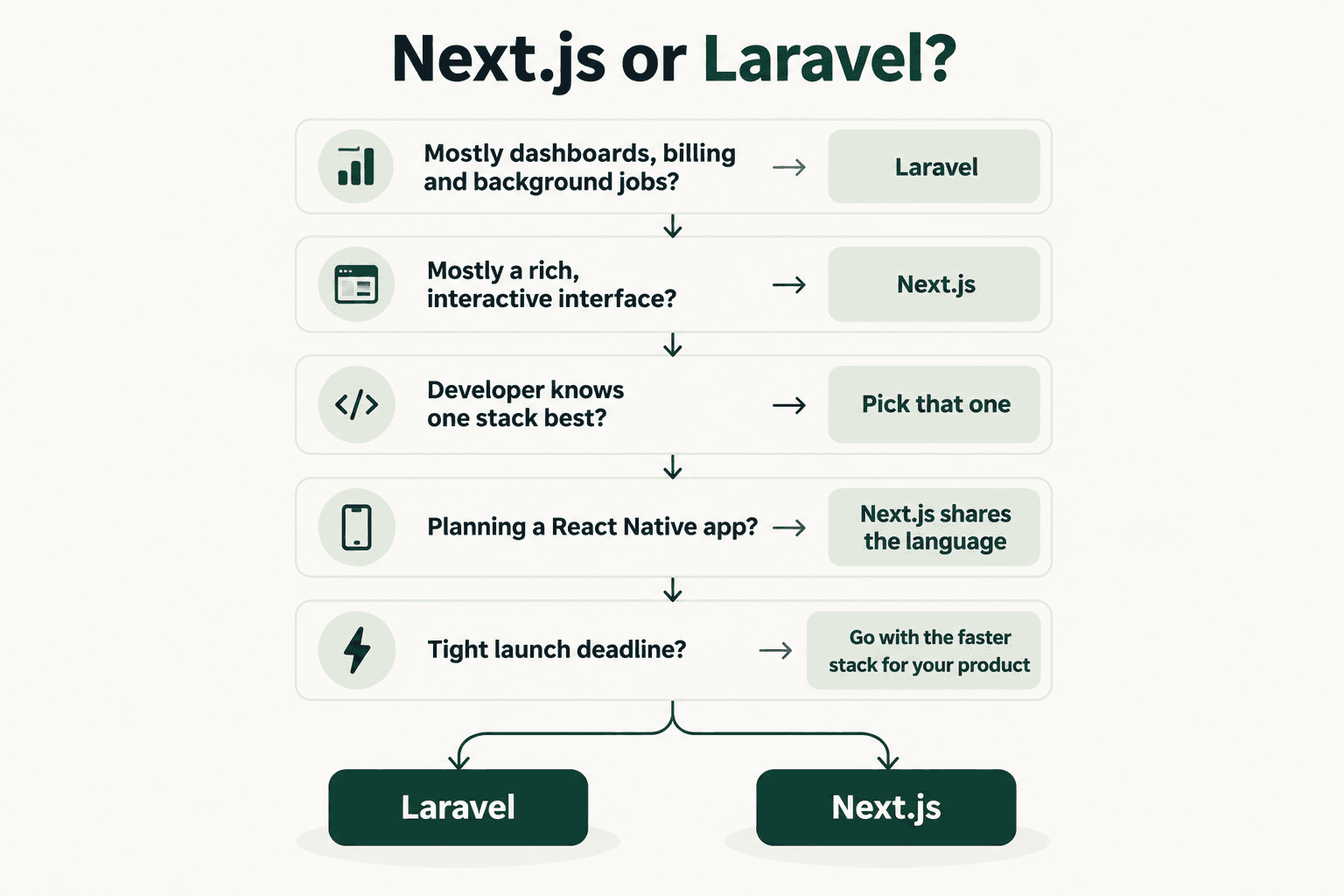
- What is most of the work? Dashboards, billing, roles, emails and jobs point to Laravel. A rich, interactive interface points to Next.js.
- What does your developer know best? Pick that one. Speed and quality come from experience.
- Will you build a mobile app soon? If you plan React Native, Next.js shares the language. If not, either stack works with an API.
- How fast must you launch? For a backend-heavy product on a tight timeline, Laravel often saves setup time. For an interface-heavy one, Next.js often does.
- Who will maintain it in a year? Choose a stack you can hire for, or one your developer will support.
If most answers point one way, you have your choice. If they are split, go with the stack your developer can ship fastest.
Our honest take
We build web apps in both Next.js and Laravel, so we do not have a favourite to sell you. Our rule is simple: start from your product, not from a trend.
For an MVP, speed to your first real users matters most. A good-enough stack that ships beats a perfect stack that never launches. You can always improve it once people are using it.
Not sure which stack fits your idea?
Tell us what you are building, and we will recommend a stack in plain English. No pressure and no jargon. Book a free 30-minute call, or learn how we build an MVP in 4 to 8 weeks.