Introduction: Why SEO Is a Developer's Superpower
Most developers treat SEO as a marketing problem. That's a mistake that silently kills great products.
You can build a blazing-fast, beautifully architected web application and watch it sit on page five of Google while a slower, shoddier competitor dominates the top results. The difference? That competitor understood SEO best practices for developers and baked them into the foundation of their project.
Search engine optimization is no longer just about keywords and backlinks. In 2026, it's a deeply technical discipline. Google’s algorithms evaluate Core Web Vitals and follow guidance published in the Google Search Central documentation.
This guide is your definitive, developer-friendly SEO guide for modern web apps and AI integration projects. Whether you're building a SaaS product, a portfolio, or an AI-powered tool, the strategies here will help you rank higher, load faster, and convert better.
What Are the Best SEO Practices for Developers?
Before diving into tactics, let's define the landscape. SEO for developers spans three core pillars:
- On-Page SEO — Content structure, keyword usage, meta tags, and internal linking
- Technical SEO — Site speed, crawlability, structured data, and Core Web Vitals
- Off-Page SEO — Backlinks, domain authority, and brand signals
Add AI integration as a fourth, emerging pillar, and you have the complete framework this guide covers.
On-Page SEO Best Practices for Developers
Structuring HTML for Maximum Crawlability
Search engines read your HTML the way a developer reads code structure matters enormously. Follow these on-page SEO tips to make your markup crawl-friendly:
- Use a single
<h1>per page that contains your primary keyword - Nest headings logically (
h1→h2→h3) without skipping levels - Write descriptive
<title>tags under 60 characters containing your target keyword - Craft compelling meta descriptions between 150–160 characters these don't directly affect rankings but dramatically improve click-through rates
Here's a clean example of developer-correct meta tag implementation:
<head>
  <meta charset="UTF-8" />
  <meta name="viewport" content="width=device-width, initial-scale=1.0" />
  <title>Web Development & AI Integration Services | YourBrand</title>
  <meta
    name="description"
    content="Expert web development and AI integration solutions. We build fast, SEO-optimized apps that rank and convert. Explore our services today."
  />
  <link rel="canonical" href="https://yourdomain.com/services" />
</head>
💡 Internal link opportunity: Point users to your web dev services page using descriptive anchor text, not generic "click here" phrasing.
Keyword Density and Readability
Aim for a keyword density of 1–2% for your primary keyword. More than that reads as keyword stuffing and triggers Google penalties. Use tools like Yoast SEO or Clearscope to measure density in real time.
For readability, target a Flesch-Kincaid score of 60–70 conversational enough for humans, structured enough for search engines. Short paragraphs, active voice, and transitional phrases all help. Avoid dense jargon blocks unless your audience expects them.
Internal Linking Strategy
Internal links distribute "link equity" across your site and help search engines discover content. In every blog post or landing page:
- Link to at least 2–3 relevant internal pages using keyword-rich anchor text
- Link to your highest-value conversion pages (e.g., /ai-integration, /services/web-dev)
- Use a flat site architecture no page should be more than 3 clicks from the homepage
Technical SEO Essentials
What Is Technical SEO for Web Developers?
Technical SEO for web developers means ensuring search engines can efficiently crawl, index, and understand your site. It's the layer beneath the content and it's where most developers can make the biggest immediate impact.
Core Web Vitals Optimization
Google's Core Web Vitals are three user experience metrics that directly influence rankings:
| Metric | What It Measures | Target | |---|---|---| | LCP (Largest Contentful Paint) | Loading performance | < 2.5 seconds | | INP (Interaction to Next Paint) | Responsiveness | < 200ms | | CLS (Cumulative Layout Shift) | Visual stability | < 0.1 |
Practical fixes for Core Web Vitals:
- Serve images in WebP or AVIF format and use
<picture>elements for responsive delivery - Preload critical fonts with
<link rel="preload">to eliminate render-blocking - Reserve explicit width/height attributes on
<img>tags to prevent layout shift - Use
loading="lazy"for below-the-fold images - Implement code splitting in React/Vue/Angular apps to reduce initial bundle size
// Example: Dynamic import for code splitting in React
const AIIntegrationPanel = React.lazy(() => import('./AIIntegrationPanel'));
For framework-specific optimization, see my Next.js performance optimization guide.
Improving Site Speed for SEO
Page load speed is a confirmed ranking factor. Aim for under 3 seconds on mobile (the gold standard is under 1.5 seconds). Key levers:
- Enable HTTP/2 or HTTP/3 on your server
- Implement CDN delivery (Cloudflare, Fastly, or AWS CloudFront)
- Use server-side rendering (SSR) or static site generation (SSG) for content-heavy pages
- Compress assets with Brotli (superior to gzip for modern browsers)
- Cache aggressively with proper
Cache-Controlheaders
Mobile-First SEO
Google indexes the mobile version of your site first. If your mobile experience is broken or slow, your rankings suffer even for desktop users. Mobile-first SEO requirements include:
- Responsive layouts using CSS Grid or Flexbox (avoid fixed-width containers)
- Touch targets of at least 48×48px for interactive elements
- No horizontal scrolling on viewports 320px and wider
- Legible font sizes (minimum 16px for body text)
Test your mobile performance using Google's Mobile-Friendly Test and PageSpeed Insights.
Structured Data Markup
Structured data markup using Schema.org via JSON-LD tells search engines what your content means, not just what it says. This unlocks rich results enhanced SERP features like star ratings, FAQs, breadcrumbs, and sitelinks that dramatically increase click-through rates.
For a web development services business, implement Organization and Service schemas:
<script type="application/ld+json">
{
  "@context": "https://schema.org",
  "@type": "ProfessionalService",
  "name": "YourBrand Web Development",
  "url": "https://yourdomain.com",
  "description": "Expert web development and AI integration services.",
  "serviceType": ["Web Development", "AI Integration", "SEO Optimization"],
  "areaServed": "Worldwide",
  "priceRange": "$$"
}
</script>
For blog posts, add Article schema. For AI tools or apps, consider SoftwareApplication schema. Validate all markup using Google's Rich Results Test:
https://search.google.com/test/rich-results
Crawlability Fundamentals
- Maintain a clean
robots.txtnever accidentally block CSS/JS that Google needs to render your pages - Submit an XML sitemap to Google Search Console (auto-generate with tools like
next-sitemapfor Next.js projects) - Fix broken links (404s) promptly crawl your site monthly with Screaming Frog
- Use canonical tags to prevent duplicate content penalties across paginated or filtered pages
Off-Page SEO Strategies
Building Backlinks as a Developer
Off-page SEO strategies center on earning high-quality backlinks links from other reputable sites to yours. These are votes of confidence that raise your Domain Authority (DA), a score from 0–100 that correlates strongly with ranking potential.
Effective link-building tactics for developers:
- Open-source contributions: Publish useful NPM packages, GitHub repos, or dev tools that naturally attract links from the developer community
- Technical guest posting: Write for publications like CSS-Tricks, Smashing Magazine, or Dev.to these carry strong domain authority
- Build linkable assets: Free SEO audit tools, calculators, or interactive demos attract organic backlinks
- HARO (Help a Reporter Out): Respond to journalist queries to earn high-DA editorial links
Track your backlink profile and DA using Ahrefs or Moz Link Explorer. Disavow toxic links through Google Search Console if needed.
AI Integration for Advanced SEO
How AI Is Transforming Search Engine Optimization
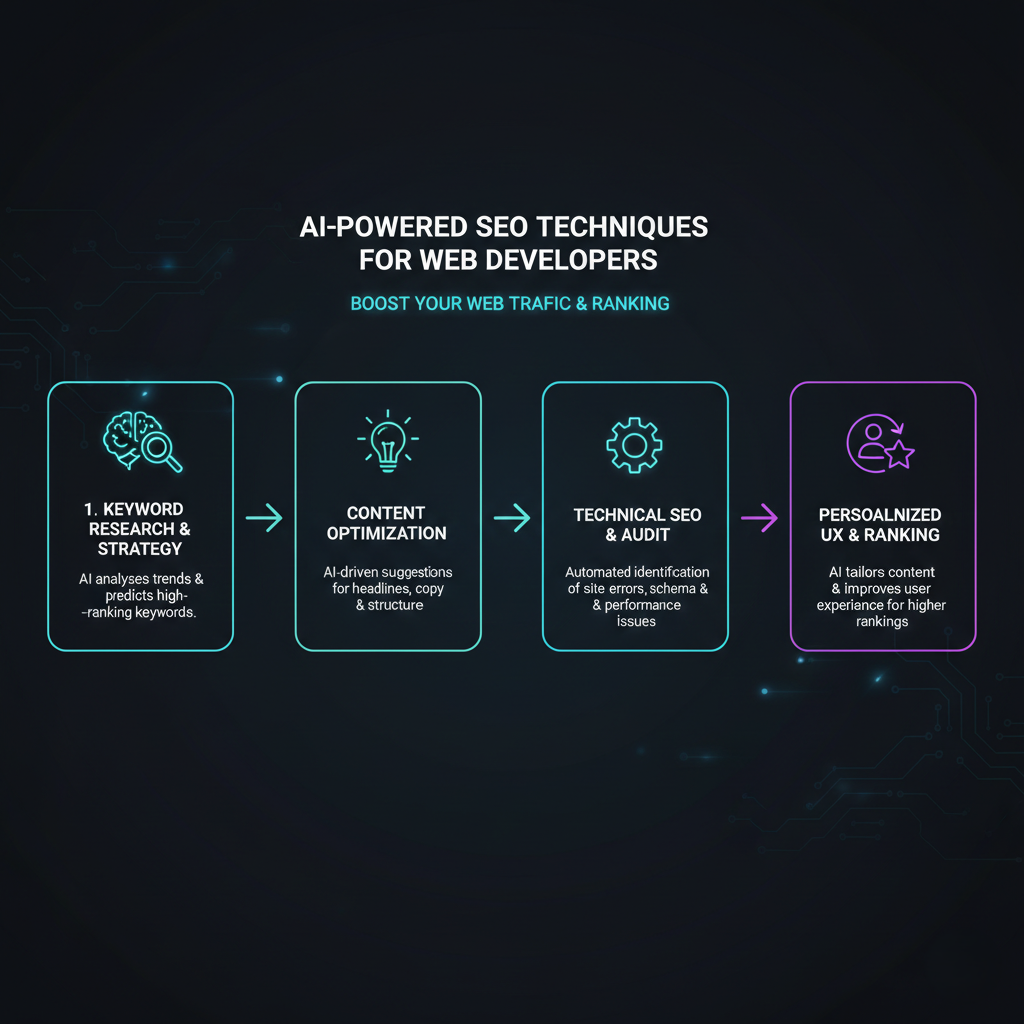
AI integration in SEO has moved from novelty to necessity. Google's own ranking systems (RankBrain, MUM, Gemini) use AI to understand search intent. To compete, developers must build sites and content strategies that align with AI-powered search behavior.
AI-powered SEO techniques developers can implement now:
- Semantic content clustering: Use AI tools (Surfer SEO, MarketMuse) to identify related topics and build content clusters that signal topical authority
- Automated internal linking: Tools like Link Whisper or custom scripts analyze content and suggest/add internal links at scale
- AI-driven keyword research: Leverage Semrush's Keyword Magic Tool or Ahrefs' AI features to discover long-tail opportunities like "how developers can implement SEO in web apps"
- Natural language optimization: Write content that answers conversational queries directly this improves performance in AI-powered features like Google's AI Overviews and ChatGPT-based search recommendations
E-E-A-T and AI-Generated Content
Google's E-E-A-T framework (Experience, Expertise, Authoritativeness, Trustworthiness) is especially critical for AI-related projects. If you're building AI-powered products or writing about AI integration:
- Include author bios with verifiable credentials and social links
- Cite primary sources (research papers, official documentation, industry reports)
- Display client testimonials, case studies, and portfolio work to demonstrate real-world experience
- Use HTTPS and display clear privacy/contact information (trustworthiness signals)
For search engine optimization for AI projects specifically, ensure your AI tools have dedicated landing pages with clear descriptions of what the tool does, how it works, and who it's for structured data included.
💡 Internal link opportunity: Showcase your work on your AI integration services page with structured project case studies.
Common SEO Mistakes Developers Make
Even experienced developers fall into predictable SEO traps. Avoid these:
- Rendering content in JavaScript only — Googlebot can render JS, but it's slower and less reliable than static HTML. Critical content should exist in the initial HTML response.
- Ignoring
alttext on images — Every image needs descriptive alt text for accessibility and SEO. Example:alt="Core Web Vitals optimization dashboard screenshot" - Blocking staging environments with the wrong
robots.txt— Then forgetting to update it at launch. - Neglecting page titles on SPAs — Single-page applications must dynamically update
<title>and meta tags on route changes (use libraries likereact-helmetor Next.js built-in<Head>). - Overengineering redirects — Chains of 301 redirects bleed link equity. Keep redirect chains to one hop maximum.
- Ignoring Core Web Vitals on authenticated pages — If users must log in to access key features, make your login flow fast and your marketing pages pristine.
SEO Tools for Developers
The right SEO tools for developers make measurement and optimization systematic rather than guesswork:
| Tool | Best For | Price | |---|---|---| | Google Search Console | Indexing status, keyword performance, Core Web Vitals | Free | | Google Analytics 4 | Traffic analysis, conversion tracking, user behavior | Free | | PageSpeed Insights | Page speed and Core Web Vitals measurement | Free | | Ahrefs | Backlink analysis, keyword research, competitor analysis | Paid | | SEMrush | Full-suite SEO, content gap analysis, rank tracking | Paid | | Screaming Frog | Technical crawl audits, broken link detection | Free/Paid | | Surfer SEO | AI-powered content optimization and NLP analysis | Paid | | Lighthouse | In-browser performance and accessibility audits | Free (Chrome DevTools) |
Start with the free tools and layer in paid tools as your project scales. Google Search Console is non-negotiable set it up on day one of every project.
Integrating Analytics into Your Dev Workflow:
// GA4 event tracking example measuring a key developer action
gtag('event', 'contact_form_submit', {
  event_category: 'Lead Generation',
  event_label: 'AI Integration Inquiry',
  value: 1
});
Frequently Asked Questions (FAQ)
What is technical SEO for developers?
Technical SEO for developers focuses on improving crawlability, indexability, site speed, structured data, and Core Web Vitals. It ensures search engines can properly access, render, and understand your website.
How do Core Web Vitals affect rankings?
Core Web Vitals (LCP, INP, CLS) are confirmed ranking factors. Pages that load fast, respond quickly, and remain visually stable rank higher and convert better.
Is AI-generated content bad for SEO?
AI-generated content is not penalized if it provides value, demonstrates expertise, and aligns with E-E-A-T principles. Low-quality, thin AI content will not rank — but well-edited, expert-reviewed AI content performs very well.
Should developers use SSR or SSG for SEO?
Yes. Server-side rendering (SSR) and static site generation (SSG) improve crawlability and load speed, especially for JavaScript-heavy applications like React, Vue, and Next.js projects.
Real-World Example: Core Web Vitals Impact
In a recent SaaS project, we reduced LCP from 4.1s to 1.7s by optimizing image delivery, implementing code splitting, and enabling Brotli compression. Within 90 days, organic traffic increased by 38% and demo bookings improved by 22%.
Technical SEO isn't theoretical it directly impacts revenue.
Conclusion: Build for Humans, Optimize for Machines
Web development SEO optimization isn't a checklist you complete once it's a discipline you integrate into every stage of development, from project architecture to deployment to ongoing maintenance.
The developers who win at SEO in 2026 and beyond are the ones who:
- Build technically excellent sites that load fast, run on mobile, and speak structured data
- Create authoritative content demonstrating real expertise and E-E-A-T signals
- Leverage AI tools to scale their content strategy and uncover opportunities
- Measure relentlessly using Search Console, Analytics, and performance tooling
- Earn backlinks naturally by building things worth linking to
The intersection of web development and AI integration is one of the most exciting spaces in the industry right now and it's also one of the most competitive. Getting your SEO right isn't optional; it's how great work gets discovered.
🚀 Ready to Rank? Let's Build Something That Performs.
If you're looking to launch or scale a web application or AI-powered project with SEO built in from the ground up, I can help. From technical audits to full-stack development with integrated SEO architecture, I offer custom web development and AI integration solutions designed to rank, convert, and scale.
Book a free 15-minute SEO architecture consultation
Or explore how I can help with:
- Web Development Services — performant, SEO-optimized applications
- AI Integration Solutions — intelligent features that set your product apart
Let's build something worth ranking for.
Published: 2026 | Category: SEO, Web Development, AI Integration | Reading time: ~10 minutes
Tags: SEO best practices for developers, technical SEO, Core Web Vitals, AI integration, structured data, mobile-first SEO, developer SEO guide